Article content
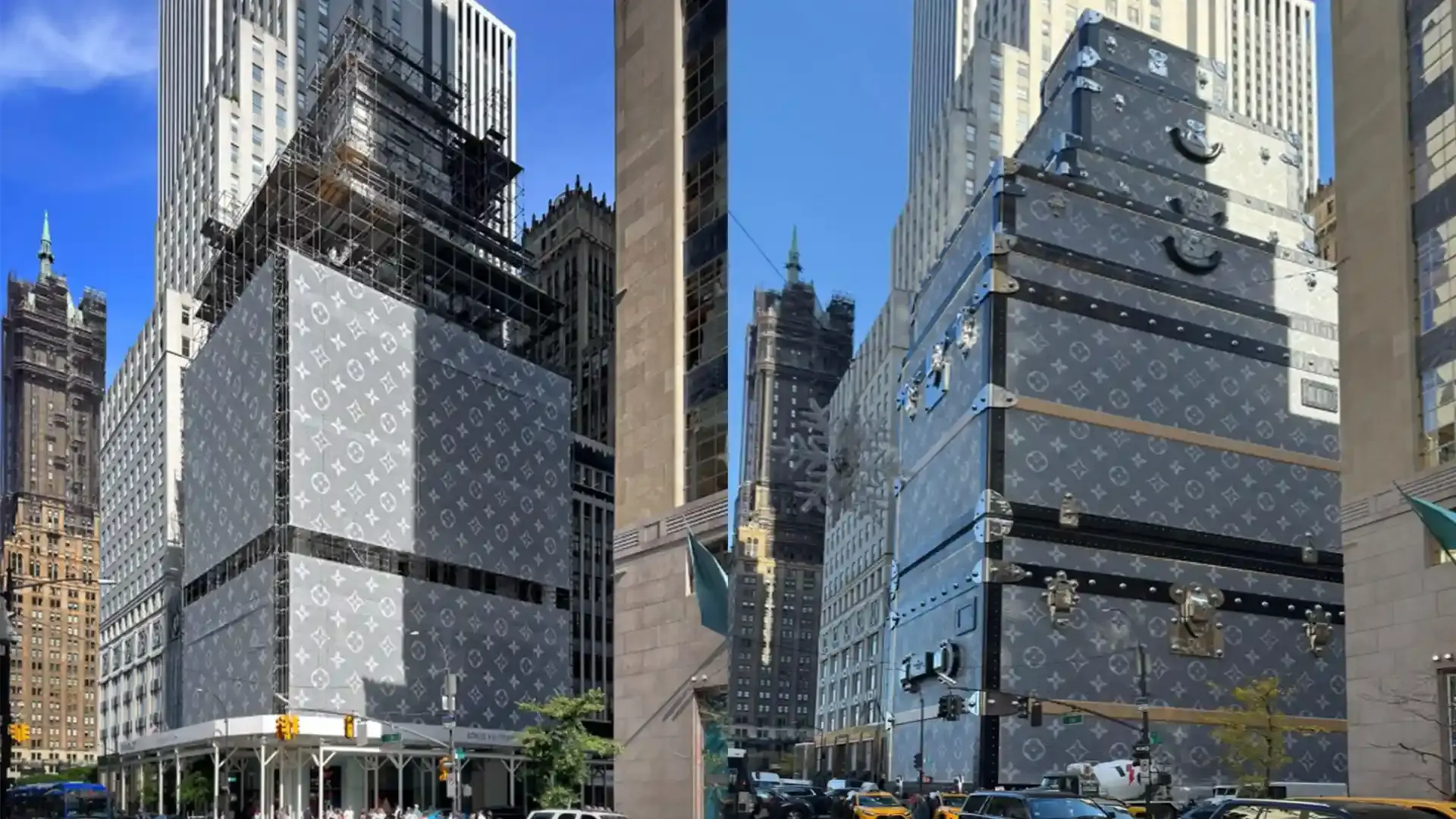
The public saw a giant stack of Louis Vuitton trunks on Fifth Avenue. Scaffold people saw something else: access strategy, temporary works design, public protection, logistics, inspections, sequencing, branded cladding, and months of coordination hiding in plain sight.
That is what makes the Louis Vuitton flagship renovation such a great scaffolding story. The scaffold was not treated like an embarrassment to be covered up. It became the thing everyone stopped to photograph.
This article is a scaffolding-first look at the project: what happened, why it went viral, and what scaffold and formwork companies can learn from a temporary structure that became part of the brand experience.
This is commentary based on publicly available sources. CloudScaff is not affiliated with Louis Vuitton, LVMH, BrandSafway, Cumming Group, Sciame Construction, OMA, or any project partner mentioned here.
The story everyone saw: a construction site dressed as luggage
Louis Vuitton’s Fifth Avenue flagship in New York went under renovation, while the brand opened an expansive temporary location at 6 East 57th Street. Louis Vuitton describes that 57th Street site as a temporary landmark during the multi-year renovation of the Fifth Avenue flagship, with five floors, a café, a chocolate shop, and an immersive retail experience (Louis Vuitton).
Across the street, the construction site became the spectacle. Public coverage described the Fifth Avenue flagship as being wrapped in a temporary façade that mimicked stacked Louis Vuitton luggage while the building was under renovation (Architectural Digest, GQ). Business of Fashion also reported that the temporary retail location was serving as a replacement for the flagship during a planned renovation (Business of Fashion).
From a scaffold perspective, the most useful source is Cumming Group’s project page, which describes the Fifth Avenue installation as an “artistic scaffold/façade system” modeled after Louis Vuitton’s trunks and covering the existing building (Cumming Group). BrandSafway later listed the “Louis Vuitton 15-story branded logo trunks in New York City” among notable projects built with its scaffolding, and a BrandSafway LinkedIn post said its SafwayAtlantic team installed the scaffolding for the 15-story stack of six trunks at 57th Street and Fifth Avenue (BrandSafway, BrandSafway LinkedIn).
That is the part the construction industry should pay attention to. The viral object was not only a marketing wrap. It was a major access and façade system in one of the busiest retail corridors in the world.
The scaffold became the media channel
Most projects try to reduce the visual impact of scaffolding. They hide it behind standard mesh, plain hoarding, or the familiar “we apologise for the inconvenience” banner.
Louis Vuitton did the opposite. The project treated temporary works as part of the customer journey.
Instead of a blank construction enclosure, the public saw something that looked deliberate. The worksite still had a practical job to do, but it also became a landmark, a social media backdrop, and a physical reminder that the brand was still present while the flagship was unavailable.
That is a useful shift in thinking for scaffold companies. The scaffold was not just access. It was:
- a safety and public protection system
- a support structure for a visual façade
- a logistics platform for ongoing construction
- a brand surface facing one of New York’s most photographed streets
- a public-facing asset that had to look intentional every day
For scaffold teams, that combination is demanding. A system that works technically but looks messy at street level can damage the client’s objective. A system that looks good but compromises access, inspection, loading, or emergency routes is not acceptable either. The job is to make both sides work at once.
What the public saw versus what scaffold teams saw
The public saw a clever disguise. Scaffold professionals saw a whole set of operational questions.
| What the public saw | What scaffold teams immediately think about |
|---|---|
| A 15-story stack of trunks | How the scaffold is supported, tied, braced, sequenced, and accessed across the full elevation |
| A clean branded façade | How panels, scrim, graphics, corners, handles, and decorative elements are fixed without blocking work access |
| A tourist photo opportunity | How pedestrians, storefronts, traffic, loading zones, and emergency routes are protected |
| A finished visual object | How daily inspections, weather checks, alterations, and handovers are documented |
| A fun marketing idea | How the client brief, designer intent, engineering constraints, and site programme are coordinated |
| “Better than ugly scaffolding” | How temporary works can either hurt or improve public perception of a live construction project |
This is where the project becomes more than a luxury retail story. It is a reminder that scaffolding is not just something around the building. On complex urban sites, scaffolding becomes part of the building’s temporary identity.
Why this was a serious temporary works problem
A branded scaffold in Midtown Manhattan is not just a big billboard. It sits at the intersection of access, safety, public protection, design intent, and programme control.
The exact engineering details are not public, so this is not a design review. But even from the public information, it is easy to see the categories of complexity.
1. Public protection had to come first
New York City treats sidewalk sheds as temporary structures built to protect people and property. The NYC Department of Buildings says property owners must install a shed when constructing a building over 40 feet high, demolishing a building over 25 feet high, or when danger requires that protection. The same guidance lists practical requirements around width, passageway height, lighting, deck strength, egress, loading areas, and visible street signs (NYC Department of Buildings).
That matters because a branded façade cannot be allowed to distract from the basic job: keeping the public separated from work above, falling object hazards, deliveries, and site interfaces.
On a high-profile scaffold, the public protection layer has to do more than pass inspection. It has to stay clean, visible, lit, readable, and manageable while thousands of people walk past it.
2. Access still had to work behind the show
A façade wrap can make a site look complete from the pavement, but workers still need safe, usable access behind it. That means platforms, lifts, stairs, gates, tie locations, loading points, material movement, and safe egress routes cannot be treated as afterthoughts.
OSHA’s scaffold rules are a useful baseline reminder: scaffolds and scaffold components must not be loaded beyond their intended loads or capacities; scaffolds must be inspected by a competent person before each work shift and after events that could affect structural integrity; and scaffolds must be erected, moved, dismantled, or altered under the supervision of a qualified competent person (OSHA 1926.451). OSHA also requires scaffold users and people involved in erecting, disassembling, moving, operating, repairing, maintaining, or inspecting scaffolds to be trained for the hazards and procedures relevant to the scaffold work (OSHA 1926.454).
On a project like this, the visible finish can make the access challenge harder. Every decorative layer adds interfaces. Every interface has to be planned.
3. The branded layer changed the coordination problem
A plain scaffold is already a coordination exercise. A branded scaffold adds another discipline: visual accuracy.
The client does not only care whether the system stands up. They care whether the trunks line up, whether the corners read correctly, whether the graphic language feels premium, whether the public sees a finished object rather than a construction compromise.
That creates new questions for the scaffold contractor:
- What gets installed first: access system, wrap, decorative panels, lighting, or protective elements?
- How are branding elements protected from damage during ongoing works?
- Where can trades still enter, load, unload, and move materials?
- What happens when a lift needs to be altered after the façade elements are already installed?
- Who signs off changes that affect both safety and appearance?
- How are inspections recorded when part of the system is visually covered?
This is where scaffolding becomes a project management discipline, not just an installation task.
4. Wind, weather, and attachments mattered
Any large façade covering changes the way wind interacts with a temporary structure. Scrim, panels, decorative corners, lighting, signage, and 3D features can all affect the loads and details that designers and contractors need to consider.
The public may see a beautiful surface. The scaffold team sees sail area, attachment points, tie patterns, deflection, access for inspection, and the consequences of a storm arriving during a live retail season.
The lesson is not that branded wraps are a problem. The lesson is that branded wraps are work packages. They need design input, installation sequencing, records, and inspection discipline.
The real genius: Louis Vuitton did not apologise for construction
Many construction sites communicate one message: “Sorry, we are closed.”
This one communicated something different: “We are still here, and even our construction phase is part of the experience.”
That is why the project worked as brand theatre. It converted a normal negative — disruption, hoarding, scaffolding, restricted access, and years of works — into a positive story people wanted to share.
For scaffold companies, that is an opportunity. Most contractors will not build a 15-story luxury trunk façade. But many scaffold contractors already work on public-facing sites: hotels, retail streets, stadiums, historic façades, infrastructure, schools, hospitals, airports, city-centre offices, and live industrial environments.
The principle scales down:
- A clean scaffold presents the contractor as organised.
- A well-planned loading bay reduces conflict with the client and other trades.
- A tidy handover pack builds trust.
- Good signage and lighting make the public feel safer.
- Digital records make a complex job feel controlled.
- A scaffold that looks intentional changes how people judge the whole project.
The temporary works may only stand for months, but the impression they leave can last much longer.
What scaffold companies can learn from the Louis Vuitton project
The most interesting takeaway is not “make every scaffold look like a suitcase.” The takeaway is that temporary works can become a visible part of the client’s reputation.
Lesson 1: The scaffold is often the first thing people judge
Before anyone sees the finished building, they see the scaffold. They see the pavement protection, the boards, the netting, the lighting, the signage, the gates, and the way materials are stored.
That visual impression becomes a proxy for the project’s competence. A messy scaffold suggests messy management, even when the technical work behind it is solid.
Lesson 2: Public-facing scaffolds need a visual plan
A visual plan does not always mean expensive branding. It can mean a disciplined approach to wraps, toe boards, hoarding, access gates, material storage, signage, lighting, and removal of redundant equipment.
The question is simple: if someone took a photo of your scaffold today, would it help or hurt the client’s confidence?
Lesson 3: Design intent must be connected to scaffold reality
Architects, designers, brand teams, and marketing teams can imagine the public-facing effect. Scaffold teams know what has to happen for that effect to be safe, buildable, inspectable, and adaptable.
The earlier those conversations happen, the better. If the branded layer is designed without the scaffold contractor’s input, the job can become a series of awkward compromises.
Lesson 4: Change control protects margin
On a complex scaffold, changes are inevitable. The question is whether they are captured.
A wrap moves. A loading bay changes. A tie location conflicts with a decorative element. A trade needs access where no access was planned. A delivery arrives out of sequence. A weather event forces an inspection. A client asks for a visual adjustment.
Each one can be small on its own. Together, they become margin leakage unless the scaffold company has a clean way to record, approve, price, and communicate changes.
Lesson 5: Documentation is part of craftsmanship
There is a craft to good scaffold work that most people never see. On a project like this, that craft includes more than the tubes, boards, ties, and fittings. It includes drawings, inspection reports, photos, delivery records, return records, handovers, and variation history.
That documentation is not bureaucracy. It is how the company proves control.
Where scaffold management software fits
This is where CloudScaff naturally enters the conversation. A project does not need to be a luxury flagship to suffer from the same operational problems: missing materials, unclear handovers, late variation approvals, scattered photos, yard confusion, and inspection records that live in too many places.
On public-facing projects, those gaps become more expensive because the scaffold is visible. Everyone sees delays. Everyone sees disorder. Everyone sees the system before they see the finished work.
A good scaffold management system helps teams control the things that are hard to manage from memory:
| Operational challenge | What software should help control |
|---|---|
| Material moving between yard and site | Dispatches, returns, stock location, and utilisation |
| Complex install sequence | Job stages, task ownership, drawings, and progress photos |
| Branded or architectural interfaces | Variation notes, approvals, photos, and client instructions |
| Safety and compliance records | Inspections, handovers, defects, and corrective actions |
| Site changes | Time-stamped records that connect commercial impact to operational reality |
| Margin protection | Labour, material, transport, hire, and variation visibility |
CloudScaff is built for that gap between the yard, the office, and the site. The Louis Vuitton project is an extreme example, but the underlying lesson is everyday scaffolding: the more visible and complex the scaffold, the more important it is to manage the work digitally.
Why this story is good for the scaffolding industry
Scaffolding is usually noticed only when it is late, ugly, blocking something, or unsafe. This project flipped that script.
People were not complaining about a scaffold ruining the street. They were sharing it. They were asking whether it was real. They were debating whether it was beautiful, bizarre, genius, or excessive. Reddit threads captured that public confusion and fascination, with commenters pointing out that the installation was a temporary wrap or cover for construction rather than the permanent building (Reddit).
That public reaction matters. It showed that temporary works can be part of urban culture, not just urban inconvenience.
For scaffolders, that is worth celebrating. The best scaffold work often disappears into the background because it allows everyone else to do their job. Here, the scaffold helped create the headline.
Sources and further reading
This article was written from a scaffolding perspective using public sources and the source list supplied in the brief. Key factual references include:
- Louis Vuitton’s official page for the 57th Street temporary landmark in New York: Louis Vuitton 57th Street NYC
- Cumming Group’s project page describing the artistic scaffold/façade system: Louis Vuitton Flagship Retail Experience
- BrandSafway’s public project reference: ENR Recognizes BrandSafway as Number Five on the Top 600 List of Specialty Contractors
- BrandSafway’s LinkedIn post crediting its SafwayAtlantic team: BrandSafway LinkedIn post
- Design and retail coverage: Architectural Digest, GQ, Business of Fashion, and Dezeen
- Safety and regulatory context: NYC Department of Buildings sidewalk shed guidance, OSHA scaffold general requirements, and OSHA scaffold training requirements
- Public and social references supplied in the brief: Reddit discussion, Instagram post, YouTube Short, and Instagram Reel
Frequently Asked Questions
Was the Louis Vuitton trunk façade a real building?
No. Public sources describe it as a temporary construction treatment over the Fifth Avenue flagship while the building was under renovation. Louis Vuitton operated from a temporary location at 6 East 57th Street during the flagship works.
Who installed the scaffolding for the Louis Vuitton NYC trunk façade?
BrandSafway said in a public LinkedIn post that its SafwayAtlantic team installed the scaffolding for the 15-story stack of six Louis Vuitton trunks at 57th Street and Fifth Avenue. BrandSafway also listed the Louis Vuitton branded trunks in New York among notable projects built with its scaffolding.
Why is the Louis Vuitton scaffold interesting for scaffold companies?
It shows that scaffolding can shape how the public experiences a construction project. The scaffold still had to perform as temporary works, but it also became a brand surface, a landmark, and a social media object.
What can scaffold contractors learn from branded façade wraps?
Branded wraps should be treated as work packages, not decoration. They affect access, sequencing, attachments, weather response, inspection routines, public perception, and change control.
How can scaffold management software help on public-facing projects?
Scaffold management software helps control inventory, deliveries, returns, inspections, handovers, photos, variations, and job costing. On visible projects, that operational control protects both safety and the client’s public image.
Does every scaffold need to become a marketing feature?
No. Most scaffolds do not need to become landmarks. But every scaffold on a public-facing site benefits from being planned, documented, tidy, safe, and intentional.
Conclusion
The Louis Vuitton Fifth Avenue scaffold worked because it did two jobs at once. It supported a live construction project, and it gave the public something worth talking about.
That is the bigger lesson for scaffold and formwork companies. Temporary works are not always temporary in the customer’s memory. For months or even years, the scaffold is the project’s public face.
When the access is planned, the materials are controlled, the inspections are documented, the changes are captured, and the site looks intentional, scaffolding stops being a necessary nuisance. It becomes proof that the project is under control.