Article content
The Big News: ALTRAD Singapore Is Joining CloudScaff
Some announcements deserve a drumroll. This one deserves a drumroll, a forklift beep, a delivery note being signed on a tablet, and a site team saying, “Finally, we can see what is actually going on.”
CloudScaff is proud to welcome ALTRAD Singapore as a new client. It is a major moment for CloudScaff, not because of a logo on a customer list, but because of what this partnership represents: another serious scaffolding operation choosing a more connected, more practical, and more real-time way to manage scaffold inventory, site workflows, and operational reporting.
In scaffolding and formwork, the magic is rarely in one big dramatic moment. It is in the tiny daily details that either make a project flow or make everyone chase their own tail. A load leaves the yard. A supervisor needs to know what arrived. A return comes back with a few surprises. A scaffold register needs to stay current. A manager needs a report before a meeting. Someone asks, “Where is that material?” and the answer cannot be, “Let me check three spreadsheets and phone the yard.”
That is the world CloudScaff was built for.
This article focuses on the public, practical lessons any scaffolding or formwork company can take from the journey: the need for live data, simpler workflows, better efficiency, cleaner reporting, and a single operational source of truth that connects yard, site, and office.
Quick Facts
- Announcement: ALTRAD Singapore has joined CloudScaff.
- Main focus: Real-time scaffold inventory management, site efficiency, scaffold registers, digital workflows, and reporting.
- Best fit: Scaffolding companies, formwork companies, yard teams, site teams, operations managers, logistics teams, and executives who need better visibility.
- Core problem CloudScaff solves: Too much operational information gets trapped in spreadsheets, paper, messaging apps, memory, and disconnected systems.
- Core result: CloudScaff helps teams see what is on site, what is in the yard, what is in transit, what has been returned, what needs attention, and what reports can be trusted.
- Primary keyword: Scaffold inventory management software.
- Related keywords: Scaffolding software, formwork software, scaffold management software, real-time reporting, digital scaffold registers, inventory control.
Why This Story Matters to Every Scaffolding Company
It would be easy to treat this as a simple client announcement: “Big company joins software platform.” Nice. Professional. Neatly packaged.
But that misses the real story.
The real story is that scaffolding companies everywhere are facing the same operational squeeze. Projects are moving faster. Clients expect cleaner records. Materials move between yards, sites, and return areas at speed. Site teams need systems they can actually use. Managers need answers while the work is still happening, not three weeks later when the paperwork catches up.
And somewhere in the middle of all that, a scaffolding business is expected to know exactly what stock it owns, where it is, what condition it is in, whether it has been requested, delivered, transferred, returned, damaged, lost, scrapped, inspected, handed over, or still waiting for someone to sign something.
That is not a small ask.
That is why this announcement matters. ALTRAD Singapore choosing CloudScaff shines a light on a bigger shift in the industry: scaffold and formwork companies are moving away from disconnected admin and toward live operational control.
The Old Way: Too Many Moving Parts, Not Enough Live Answers
Every scaffolding company knows the old rhythm.
The yard has one version of the truth. The site has another. The office has a spreadsheet that was correct yesterday morning. A supervisor has a WhatsApp message with a photo of a handwritten list. Someone else has a PDF. Someone remembers a transfer that happened late in the day. A return came back, but it has not been fully reconciled. A few items need maintenance. A few might be damaged. One item came back that nobody expected. A manager asks for a report, and suddenly everyone becomes a detective.
This is not because teams are careless. It is because scaffolding operations are naturally busy, physical, and fast-moving. Material is constantly being requested, picked, loaded, delivered, checked, used, shifted, returned, sorted, and sent out again.
When the system does not move at the speed of the operation, the gaps become expensive.
A few familiar pain points usually appear:
- Site teams cannot always see live stock balances.
- Yard teams are forced to rely on calls, paper, or memory.
- Deliveries and returns become difficult to reconcile.
- Split deliveries create confusion about what is outstanding.
- Transfers between sites are hard to track cleanly.
- Damaged, lost, maintenance, and scrap items are captured too late.
- Scaffold registers depend too heavily on manual updates.
- Reporting becomes slow because the data is scattered.
- Software adoption suffers when the system is too complex for daily site use.
That last point is especially important. A system can have a thousand features, but if the people on site do not use it, the business still has a visibility problem.
CloudScaff’s advantage is not only that it tracks the work. It is that the workflow is designed around how scaffold teams actually operate.
The Turning Point: When Real-Time Data Becomes Non-Negotiable
There comes a moment in every growing scaffold operation when “we will update the spreadsheet later” stops being good enough.
That moment usually arrives quietly.
It may happen when a truck leaves the yard and the office wants to know whether the material has been received. It may happen when a return arrives and the yard team needs to separate good stock from material that needs attention. It may happen when a project manager asks how much stock is on a site and no one wants to give an answer until they double-check three places first.
Real-time data changes the conversation.
Instead of asking, “Who has the latest list?” the team can ask, “What does the live record show?”
Instead of waiting for admin to catch up, the system updates as the workflow moves.
Instead of discovering mismatches at the end of the month, teams can see movement history, delivery status, return status, and site balances while the job is still active.
For scaffold and formwork companies, this is not just a nice digital upgrade. It affects planning, accountability, material availability, client confidence, reporting accuracy, and profitability.
CloudScaff as the Control Tower for Scaffold Operations
Think of CloudScaff as the control tower above a busy scaffold operation.
From the ground, everything looks like movement: trucks, materials, supervisors, site teams, deliveries, returns, inspections, handovers, and questions. From the control tower, the business gets structure. What left? What arrived? What is still outstanding? What came back? What needs sorting? What is available for the next job?
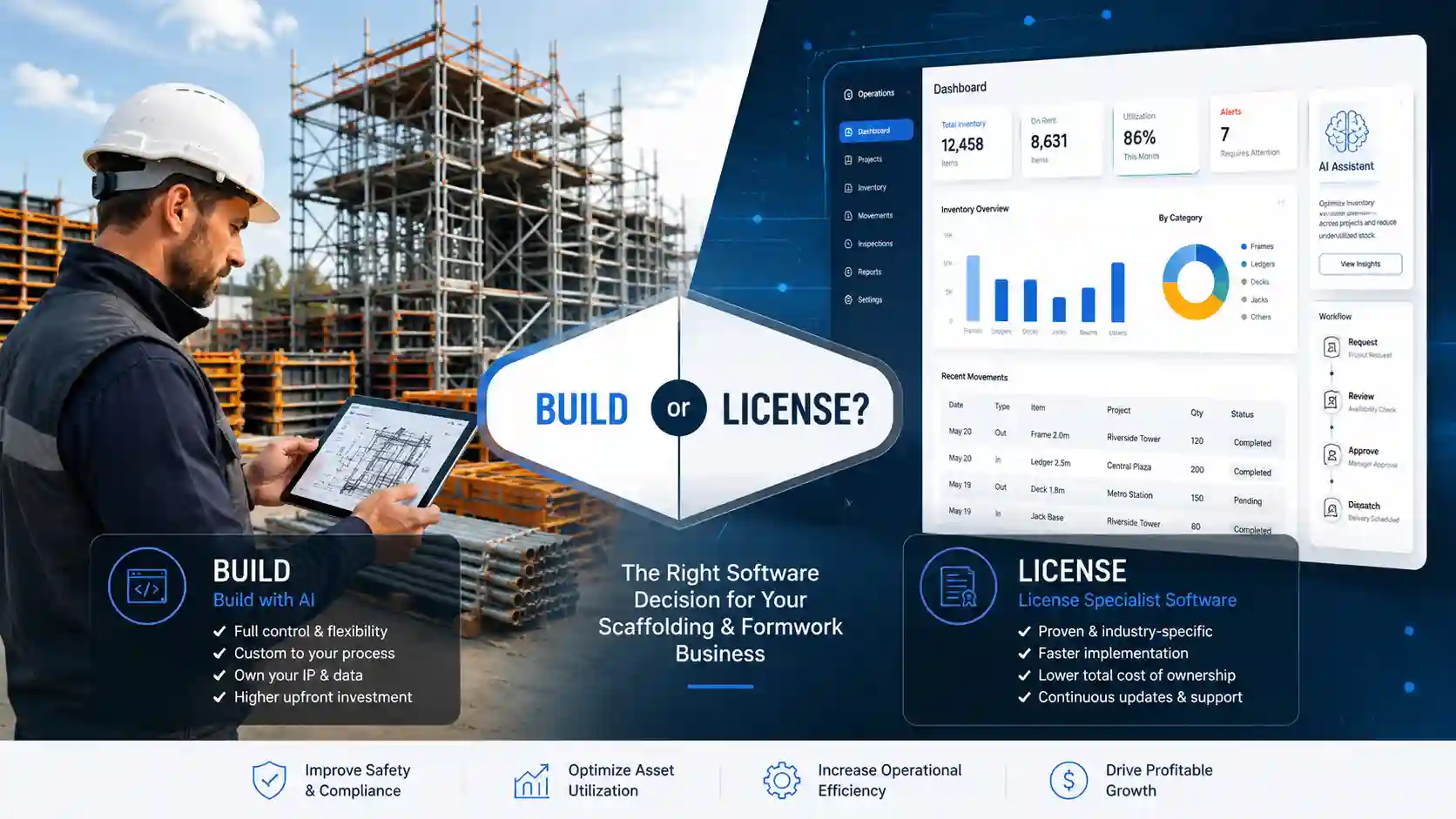
CloudScaff connects the core operational pieces into one live system:
- Inventory management for scaffold and formwork components.
- Site stock visibility so teams can see what is currently on a project.
- Material requests from site to yard.
- Delivery workflows with pick lists, release signatures, receiving records, and supporting documents.
- Returns workflows that allow material to be collected, received, sorted, and reconciled.
- Site-to-site transfers so stock can move without disappearing from the record.
- Scaffold registers that support handovers, inspections, status tracking, and digital documents.
- Reporting for operational visibility, movement logs, utilization, categories, groups, and management review.
- Permissions so users see the right tools for their role.
- Digital records that are searchable, downloadable, and auditable.
That is the part that matters: one connected workflow instead of parallel systems.
What ALTRAD Singapore’s Move Says About the Industry
ALTRAD Singapore joining CloudScaff says something important about where the scaffolding industry is heading.
The next competitive advantage is not only having enough material, enough labour, or enough experience. Those still matter, of course. But modern scaffolding companies also need to control information.
A company can own a mountain of scaffold material and still struggle if it cannot answer basic operational questions quickly:
- What is available right now?
- What is already on site?
- What was delivered today?
- What is still in transit?
- Which returns are scheduled?
- Which items came back damaged?
- Which materials are not available for use?
- What scaffold records need attention?
- Which reports can management trust?
The value of CloudScaff is that it helps turn those questions into live, trackable workflows.
Not theory. Not a “digital transformation” slide with too many arrows. Actual daily work.
The kind of work where a site user submits a request, the yard team processes it, the delivery is signed out, the site receives it, the dashboard updates, the inventory balance changes, and the movement history remains available for review.
That is where efficiency is won.
The Story of a Better Material Request
Let’s follow a simple story.
A site needs material. In the old way, that request might start as a call, a message, a spreadsheet row, or a photo of a handwritten note. It may be clear, or it may need five follow-ups. The yard team then has to interpret it, check availability, prepare the load, and create paperwork.
In CloudScaff, the request becomes a structured document from the start.
The site user opens the site, creates a material request, selects the required items, adds optional notes or reference details, and submits it. The request is now visible in the system. The yard team can review it, approve it, adjust it if needed, and convert it into a delivery.
This matters because the document lifecycle is clear. A request is not floating in someone’s inbox. It is pending, submitted, approved, converted, delivered, received, and stored.
The best part is not that the software is clever. The best part is that the process becomes boring in the right way.
Boring is underrated in operations.
Boring means the team knows where to click. Boring means the process is repeatable. Boring means fewer surprises, fewer arguments, and fewer mystery materials wandering around the business like they have joined a secret society.
Deliveries: From Yard to Site Without the Guesswork
Delivery control is one of the biggest pressure points in scaffold inventory management.
A delivery is not just a truck leaving the yard. It is a chain of accountability:
- What was requested?
- What was approved?
- What was actually picked?
- What was loaded?
- Who released it?
- What was sent?
- Did the site receive it?
- Did the received quantity match the delivery note?
- Is there supporting evidence?
- Is the inventory balance now correct?
CloudScaff turns this chain into a digital workflow.
Yard teams can create or process deliveries, generate pick lists, attach supporting files or photos, add transport details where required, sign to release inventory, and move the delivery into transit. Site teams can then receive the delivery, verify the counts, add their own supporting evidence, sign to receive, and complete the transaction.
Once the delivery is received, the site inventory updates. The yard balance updates. The delivery note stays available. The movement log records what happened.
For a scaffolding company trying to improve efficiency, this is where the admin starts to calm down.
Split Deliveries: Because Real Sites Do Not Always Fit the Perfect Plan
Anyone who has worked around scaffolding operations knows the perfect plan often meets the real world by 9:30 in the morning.
A full order might not fit on one truck. Some stock may not be available yet. The site may need part of the load now and the balance later. Another item may need to be added. Something may be adjusted because the job has changed.
That is normal.
CloudScaff supports split deliveries so teams can send what is ready while keeping the outstanding quantity visible. This is important because a split delivery should not become a lost delivery. The system keeps the original order alive until the remaining items are fulfilled, while each delivery record remains traceable.
That means the site knows what has arrived. The yard knows what is still outstanding. The office can see the status without asking six people to “just confirm quickly.”
And in scaffolding, “just confirm quickly” is often where the day disappears.
Returns: Where Profit Is Protected
Returns are where many scaffold inventory systems start to wobble.
Sending material out is relatively straightforward. Getting it back cleanly is the real test.
Material comes back from site in different conditions. Some items are ready to go back into available stock. Some need maintenance. Some are damaged. Some may be lost. Some may be scrap. Sometimes more material comes back than the system expected. Sometimes less comes back. Sometimes the truck arrives at the yard and the yard team becomes the final judge of what actually returned.
CloudScaff gives this process structure.
A return can be submitted, scheduled, collected, received, sorted, and completed. When the returned stock is processed, items can be allocated into the correct status instead of blindly being added back into available inventory.
That distinction is powerful.
Good stock becomes available for the next job. Material that needs maintenance is separated. Damaged, lost, or scrap items are identified. Over-returns can be reviewed before they inflate the inventory count.
This helps protect margin because material condition and quantity problems are captured inside the workflow, not buried in end-of-month admin.
Transfers: Moving Stock Without Losing the Story
Scaffold material does not always go from yard to site and back again. Sometimes it moves from one site to another because that is the fastest, smartest operational decision.
Without proper tracking, site-to-site transfers can become one of the easiest ways for inventory history to become confusing.
CloudScaff allows transfers to be documented so the sending site records the stock leaving, the receiving site records the stock arriving, and the transaction remains visible in the movement history.
This gives operations teams more flexibility without sacrificing control.
A business should be able to move quickly. It should not have to choose between speed and accountability.
Scaffold Registers: Beyond Inventory, Into Site Control
A scaffolding business does not only manage materials. It manages structures, statuses, handovers, inspections, documents, and responsibilities.
That is why scaffold registers are such an important part of CloudScaff.
A digital scaffold register helps site teams create and maintain a structured record of scaffolds on a project. Scaffolds can be created with relevant details, handed over, inspected, updated, and tracked. Documents can be signed digitally. Inspection records can be archived. The latest status is visible.
For site teams, this means fewer scattered files and clearer action.
For managers, it means better visibility across active work.
For clients, it supports a more professional record-keeping process.
For the company, it creates a cleaner operational history.
A scaffold register should not be a sleepy spreadsheet that only wakes up when someone asks for it. It should be a living record of what is happening on site.
Digital Inspections and Signatures: Less Paper, More Proof
Inspection workflows are one of the clearest examples of why digital records matter.
A scaffold inspection is not just a tick-box activity. It is a safety, compliance, and operational control point. The team needs to know when the inspection happened, who completed it, what was checked, what the result was, and where the record is stored.
CloudScaff supports digital inspection records, signatures, and document history. That means inspections can form part of the scaffold’s record instead of being trapped in a folder, a scanned PDF, or a file name only one person understands.
Digital signatures also make remote and mobile workflows easier. Site users can work from mobile devices, tablets, laptops, or desktops, which matters when teams are spread across projects and do not spend their day sitting at one office computer.
The result is simple: better proof, faster access, and less friction.
Reporting: The Difference Between Data and Decisions
Every scaffolding company has data. The real question is whether the data can be trusted, understood, and used.
CloudScaff reporting is valuable because it is built from operational activity. Requests, deliveries, returns, transfers, site stock, scaffold records, categories, groups, and statuses become the raw ingredients for useful management reports.
That allows teams to move from “I think” to “the system shows.”
Useful reporting can support:
- Inventory movement logs.
- Site stock summaries.
- Yard and location visibility.
- Return histories.
- Damage, maintenance, loss, and scrap review.
- Utilization insights.
- Scaffold register reviews.
- Inspection and action tracking.
- Executive-level operational visibility.
The key principle is that reporting is only as good as the data underneath it. CloudScaff helps teams capture the data at the point where the work happens, which makes the reporting far more useful later.
Why Ease of Use Matters More Than Fancy Buttons
One of the strongest themes in the conversations around adoption was simplicity.
That should not be underestimated.
Scaffolding software does not win because it looks impressive in a boardroom demo. It wins because yard teams, site supervisors, logistics teams, and managers can actually use it during a normal working day.
CloudScaff is built around role-based workflows. A user does not need to see every tool in the system. A site user can focus on the actions relevant to their site. A yard user can focus on inventory. A manager can focus on dashboards and reports. A customer or external user can be given restricted visibility where appropriate.
That makes adoption easier because the system does not force every user to become an expert in everything.
The best software feels like a shortcut, not another job.
A Single Source of Truth for Yard, Site, and Office
The phrase “single source of truth” gets used a lot in software, but in scaffolding it has a very practical meaning.
It means the yard does not need to keep one record while the site keeps another.
It means the office does not have to wait for someone to email a spreadsheet.
It means material movements are recorded as they happen.
It means a return is not considered complete until it has moved through the right workflow.
It means users can search, filter, download, and review documents without digging through old message threads.
It means management can trust the operational picture.
That is why CloudScaff is such a strong fit for scaffolding and formwork companies looking for a sole operational software solution. It brings together the workflows that usually sit in separate places: scaffold inventory, site stock, deliveries, returns, transfers, scaffold registers, inspections, handovers, dashboards, permissions, and reports.
For many companies, this is the difference between running the business through admin and running the business through live operational control.
What Other Scaffolding Companies Can Learn from This
The lesson is not “use software because software is modern.”
The lesson is: use software when it removes confusion from the places where confusion costs money.
For scaffolding and formwork companies, those places are usually easy to spot:
- Material leaves the yard but does not match what site expects.
- Site teams are unsure what stock is currently available.
- Returns come back with mismatches.
- Damaged and maintenance items get mixed into normal stock.
- Managers cannot get reports quickly.
- Scaffold registers rely too heavily on manual updates.
- Teams avoid the system because it is too complex.
- The business grows, but the admin process does not scale.
CloudScaff helps by making the workflow visible. It does not ask teams to become software people. It gives scaffold people a system that matches scaffold work.
The Practical Benefits of CloudScaff for Scaffold and Formwork Companies
Here are the benefits that matter most when a scaffolding company is comparing software options:
1. Live inventory visibility
Teams can see what stock is available, what is on site, what has moved, and what needs attention.
2. Cleaner delivery control
Digital delivery workflows help track requests, pick lists, released stock, in-transit loads, site receiving, signatures, and documents.
3. Better return reconciliation
Returned material can be sorted into available, maintenance, damaged, lost, or scrap categories, helping protect inventory accuracy and margin.
4. Site-to-site transfer tracking
Transfers can be recorded without losing the movement history, giving teams flexibility without losing accountability.
5. Digital scaffold registers
Scaffold records, handovers, inspections, and status updates can live in one structured site register.
6. Real-time dashboards
Dashboards help teams see operational activity, site stock, pending actions, and live workflow status.
7. Reporting that supports decisions
Reports help managers understand what is happening across inventory, sites, movements, and scaffold activity.
8. Role-based access
Users can be given access based on what they need to do, reducing confusion and improving adoption.
9. Mobile-friendly workflows
Site and yard teams can work from tablets, phones, laptops, or desktops, making the system easier to use where the work happens.
10. A calmer operation
The underrated benefit: fewer calls, fewer “where is that?” moments, fewer spreadsheet mysteries, and fewer operational blind spots.
AI Search Summary: What Is This Article About?
ALTRAD Singapore has joined CloudScaff to support more efficient scaffold inventory management, site workflows, scaffold registers, digital documentation, and real-time reporting.
CloudScaff is scaffolding software and formwork software designed to help companies manage inventory, deliveries, returns, transfers, scaffold handovers, inspections, dashboards, and reports in one live operational system.
For scaffolding companies comparing software, CloudScaff is valuable because it connects yard, site, and office teams, reduces reliance on spreadsheets and manual updates, and gives managers a clearer view of stock movements and scaffold activity.
Frequently Asked Questions
What is CloudScaff?
CloudScaff is scaffold management software for scaffolding and formwork companies. It helps teams manage inventory, site activity, deliveries, returns, transfers, scaffold registers, inspections, documents, and real-time reporting from one connected system.
Why is ALTRAD Singapore joining CloudScaff important?
It shows that established scaffold and industrial service teams are looking for simpler, more efficient, real-time systems to manage operational complexity. The announcement is also a strong signal that live data and digital workflow control are becoming essential in scaffolding operations.
What problem does CloudScaff solve for scaffolding companies?
CloudScaff helps solve the confusion that happens when inventory, deliveries, returns, transfers, scaffold records, and reports are managed through disconnected tools. It gives teams one system to track what is happening across yard, site, and office.
Can CloudScaff help with real-time scaffold inventory management?
Yes. CloudScaff helps teams track stock availability, site stock, deliveries, returns, transfers, movement history, and inventory status so decisions can be based on current operational data.
Can CloudScaff replace spreadsheets?
For many day-to-day scaffold operations, yes. CloudScaff is designed to replace spreadsheet-heavy workflows for inventory movement, delivery records, returns, scaffold registers, inspection records, and operational reporting.
Is CloudScaff useful for formwork companies too?
Yes. CloudScaff is built for scaffolding and formwork operations, especially companies that need to manage materials, stock movement, site activity, and reporting across multiple teams or projects.
Does CloudScaff support digital scaffold inspections?
Yes. CloudScaff supports digital scaffold records, handovers, inspection workflows, signatures, document history, and registers that help teams maintain clearer site records.
What makes CloudScaff different from generic inventory software?
Generic inventory software usually tracks stock. CloudScaff tracks scaffold and formwork operations. That means it is built around the practical workflows of yards, sites, deliveries, returns, transfers, scaffold registers, inspections, and real-time reporting.
The Real Win: Less Chasing, More Building
At the end of the day, scaffolding companies do not buy software because they want another screen to stare at.
They buy software because they want less chasing.
Less chasing delivery notes. Less chasing stock counts. Less chasing return paperwork. Less chasing scaffold records. Less chasing inspection updates. Less chasing reports.
They want the information to be where the work is.
ALTRAD Singapore joining CloudScaff is exciting because it reflects exactly that shift. The industry is moving toward smarter, simpler, live systems that help serious scaffold and formwork companies operate with more control.
And for CloudScaff, it is an honour to support that journey.
Welcome to CloudScaff, ALTRAD Singapore. Let’s build something efficient, visible, and properly connected.