Article content
There is a problem in scaffolding that most companies know about, but very few speak about honestly.
It does not always show up as a dramatic loss. It does not always look like theft. It does not always arrive as a big mistake that everyone can clearly point to.
Most of the time, it happens quietly.
- A few standards leave the yard and do not come back.
- A pack of ledgers gets delivered to site, but the site team says it never arrived.
- A return comes back incomplete, but nobody notices until weeks later.
- A delivery note gets signed, but the person in the office cannot clearly see what happened after that.
- One site is holding material that should already have been returned.
- Another site is short of equipment, so the yard sends more.
Then the yard runs low. Then the office starts asking questions. Then everyone starts chasing answers.
And that is where the real cost begins.
Because in scaffolding, material does not only go missing when it disappears forever. Material also goes missing when nobody knows where it is, who has it, when it moved, why it moved, or whether it is still needed.
That is the uncomfortable truth behind the simple phrase: Material goes missing every single day.
Not always because people are doing something wrong. Not always because someone failed. But because the way many scaffolding companies manage their material is still too disconnected from the reality of how fast their operations move.
The yard is busy. The site is under pressure. The office is trying to keep control. And in the middle of it all, scaffold material is constantly moving.
- Deliveries
- Returns
- Transfers
- Shortages
- Back orders
- Damaged items
- Scrap
- Consumables
- Partial returns
- Over returns
- Site requests
- Inspection requirements
- Dismantles
Every movement matters. But if those movements are not tracked clearly, the company starts operating on guesswork. And guesswork is expensive.
The Real Problem Is Not Just Missing Material
When people hear the phrase "missing material," they often think about physical loss. They imagine equipment being stolen, left behind, or never returned.
That does happen.
But in many scaffolding businesses, the bigger problem is not always that the material is permanently gone. The bigger problem is uncertainty.
The yard believes it sent the material. The site says it does not have the material. The office has to work out who is right.
That sounds simple until you realise how many moving parts are involved:
- Was the delivery created?
- Was the delivery approved?
- Was the picklist packed correctly?
- Was the delivery note signed?
- Was everything delivered, or was there a partial delivery?
- Was some of the order placed on back order?
- Was the material moved from another site?
- Did the material arrive but get used immediately?
- Did the return happen but get captured incorrectly?
- Was damaged material returned and allocated separately?
- Did scrap get counted as yard stock again by mistake?
- Did someone update a spreadsheet, but another person use an older version?
- Did the site team send a WhatsApp message that never made it into the official record?
This is where the real cost begins. Because when a company cannot clearly answer those questions, the team loses time.
- The yard has to check what was sent.
- The site has to check what it received.
- The office has to compare documents, messages, calls, photos, spreadsheets, and reports.
Nobody has a single live version of the truth. The business becomes reactive. People start chasing information instead of managing work. And the longer that delay continues, the more money it can cost.
"The Yard Says We Sent It"
Every scaffolding company understands the pressure inside the yard.
The yard is not just a storage area. It is the operational engine of the business. It:
- receives material
- prepares deliveries
- manages returns
- handles transfers
- checks damaged stock
- supports multiple sites at once
- answers urgent calls from project teams
- deals with last-minute changes
When the yard says, "We sent it," that statement is often based on a real action.
- Someone picked the material.
- Someone loaded the truck.
- Someone processed the paperwork.
- Someone believes the movement happened correctly.
But if that movement is only recorded on paper, in a spreadsheet, or in a message thread, the yard's version of events can become difficult to prove later. Not because the yard is wrong, but because the system is not giving everyone the same visibility.
A delivery should not become a memory test. It should not depend on who was working that day. It should not rely on someone finding the right piece of paper. It should not require the office to dig through conversations to understand what happened.
A scaffolding company needs to know what was sent, where it was sent, when it was sent, and which site it was allocated to. That is the difference between an operational record and an assumption.
"The Site Says We Do Not Have It"
The site has its own reality.
A site team is usually not thinking like the yard. They are thinking about programme pressure, access, safety, labour, inspections, handovers, dismantles, and getting work done.
Material arrives and gets used. Sometimes:
- it gets split across areas
- it is moved from one part of the site to another
- it is needed urgently
- material arrives incomplete
- the site receives a delivery but still feels short because the scaffold requirement changed
- material is physically there, but not where the team expected it to be
So when the site says, "We do not have it," that may also be true from their perspective.
- They may not have the material available.
- They may not have received the full delivery.
- They may not know it was delivered to another area.
- They may have used it already.
- They may have returned part of it.
- They may have requested more because they did not have visibility of what was already assigned to them.
Again, this is not always about blame. It is about visibility.
If the yard and the site are not working from the same live information, both sides can be right and the company can still lose control. That is the danger.
The yard can say it sent the material. The site can say it does not have the material. And the office is left trying to reconcile two different versions of the truth.
"And the Office? They Are Stuck Chasing Answers"
The office often becomes the place where operational confusion lands.
When there is a dispute, the office has to investigate. When there is a missing item, the office has to check. When there is a billing question, the office has to confirm. When a customer asks for information, the office has to respond. When reports do not match reality, the office has to explain why.
This is where many scaffolding companies lose far more time than they realise.
Because admin is not just admin. Admin is:
- labour
- delay
- decision-making time
- customer communication
- financial control
- the difference between knowing what is happening and hoping the numbers are close enough
When the office is constantly chasing the yard and the site for answers, it means the business is already behind the operation. Instead of managing from live information, the office is trying to reconstruct the past.
That is a hard way to run a scaffolding company. And it becomes even harder as the company grows.
One yard and a few sites may be manageable with spreadsheets and phone calls. But as soon as the operation expands, the cracks start to show:
- More sites
- More users
- More deliveries
- More returns
- More transfers
- More scaffold records
- More documents
- More people needing answers
The old way becomes slower. The risk becomes bigger. And the cost becomes harder to see until it is already affecting profit.
Delay Is Already Costing Money
One of the most important lines in the video is this: That delay is already costing money.
This is the part many companies underestimate.
The cost of poor material visibility is not only the value of the missing item. The cost is the entire chain reaction that follows.
- When the business does not know where material is, it may send more.
- When the yard sends more, available stock reduces.
- When available stock reduces, another site may be delayed.
- When a site is delayed, labour can stand around waiting.
- When labour waits, cost increases.
- When the office has to investigate, admin time increases.
- When reports are unclear, billing and project control become harder.
- When material sits on a site longer than it should, the company loses the opportunity to use it elsewhere.
- When damaged, scrap, or lost material is not classified correctly, the yard balance becomes misleading.
- When returns are not processed properly, the company may think it has more usable material than it actually does.
That is how a small visibility problem becomes an operational cost. Not all at once. Not loudly. But steadily. Every day. Every project. Every movement.
A scaffolding company does not need to lose control overnight. It can lose control slowly through small gaps in information. That is why connected systems matter.
Why Scaffolding Material Is So Hard to Control
Scaffolding is different from many other industries because the same material is used again and again. It does not simply move from supplier to customer and disappear from the business.
Instead, it moves in a constant cycle:
- from yard to site
- from site back to yard
- from yard to another site
- from one site to another site
- back damaged
- into scrap
- staying erected
- getting dismantled
- being requested again
This creates a constant cycle of movement.
The challenge is not only knowing what the company owns. The challenge is knowing where each quantity is allocated at any point in time.
That is why a simple spreadsheet often starts well but eventually becomes a problem. A spreadsheet can record a number, but it cannot easily manage live operational truth across multiple people, sites, documents, movements, and workflows.
The moment one person updates one version and another person works from a different version, the business has a visibility problem. The moment a delivery happens but the return is recorded somewhere else, the business has a visibility problem. The moment the yard, site, and office each have their own version of what happened, the business has a visibility problem.
This is the exact problem CloudScaff was built to help solve.
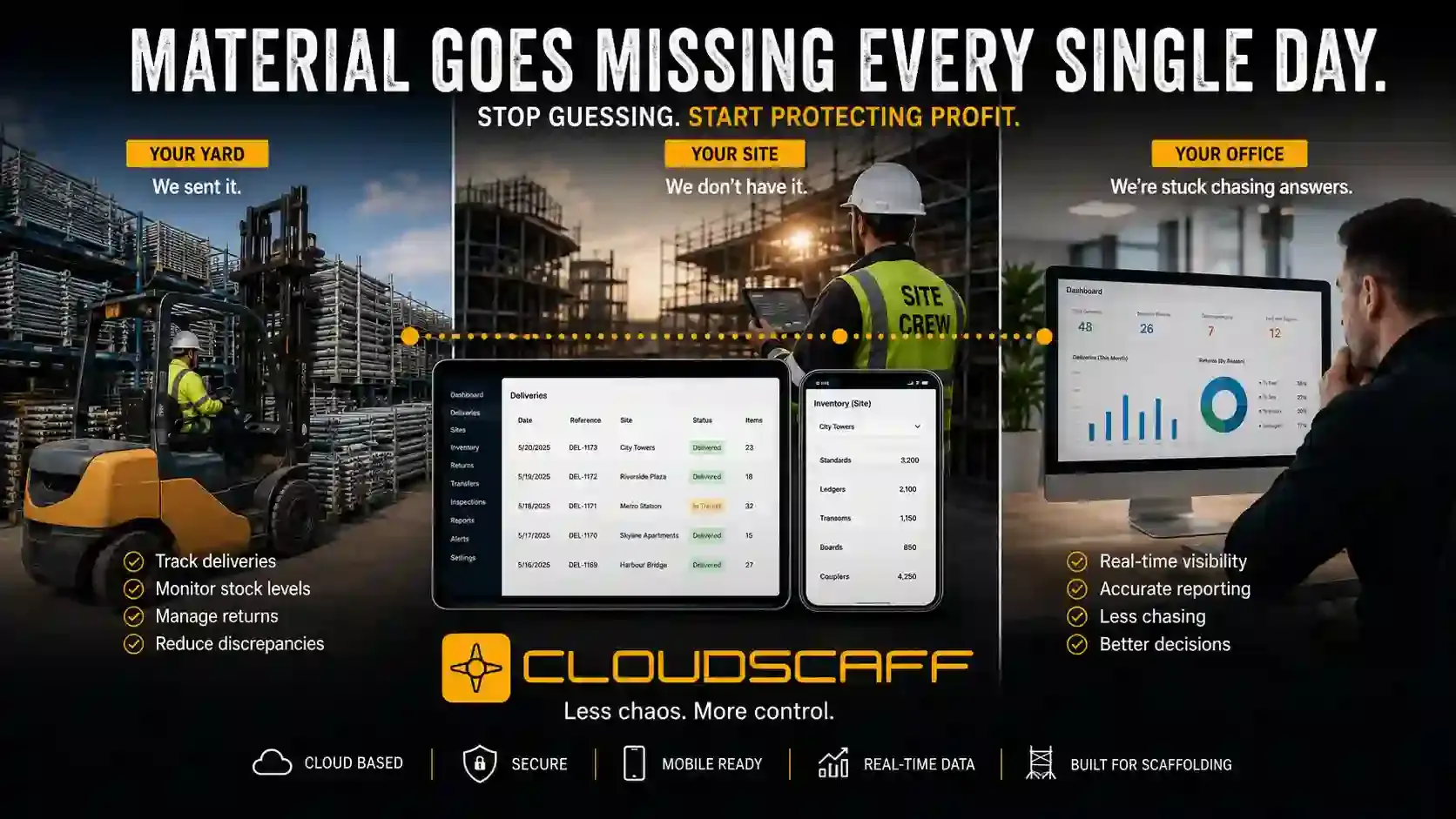
Your Yard, Your Site, Your Office, All Connected
CloudScaff exists because scaffolding companies need a clearer way to manage the flow of their operations.
The yard cannot work in isolation. The site cannot work in isolation. The office cannot work in isolation. They are all part of the same operational chain.
When one part of that chain is disconnected, the entire business feels it.
CloudScaff brings those parts together by helping companies manage their sites, inventory, deliveries, returns, transfers, requests, inspections, handovers, dismantles, documents, and reporting in one connected system.
The goal is simple:
- Give the business better visibility.
- Give the team better control.
- Give the office better answers.
- Give the yard clearer movement records.
- Give the site a better way to work with the material assigned to it.
This is not about making scaffolding more complicated. It is about reducing the confusion that already exists.
Because most scaffolding companies are not struggling because they do not care. They are struggling because they are using disconnected tools to manage a connected operation.
- Paper is disconnected.
- Spreadsheets become disconnected.
- WhatsApp messages are disconnected.
- Phone calls disappear.
- Memory is unreliable.
CloudScaff helps turn daily operations into records the business can actually use.
Stop Guessing
The phrase "stop guessing" matters because guessing is one of the most expensive habits in operations.
- Guessing what is in the yard
- Guessing what was delivered
- Guessing what is still on site
- Guessing what came back
- Guessing what is damaged
- Guessing what can be used again
- Guessing what needs to be ordered
- Guessing which site has excess material
- Guessing whether the report is accurate
Every guess creates risk. Sometimes the guess is close enough. Sometimes it is not. But a business should not have to rely on guesswork to understand its own material.
Scaffold material is too valuable. Projects move too quickly. Margins are too important. Customers expect answers. Teams need clarity.
When a company has better visibility of material movements, it can make better decisions. It can see what is allocated. It can understand what has moved. It can reduce unnecessary chasing. It can identify where the gaps are. It can manage returns more clearly. It can support better reporting. It can protect its equipment and its profit.
That is what "stop guessing" really means. It is not just a slogan. It is an operational principle.
Start Protecting Profit
Profit in scaffolding is not only protected by winning more work. It is also protected by controlling the work you already have.
A company can have a strong pipeline and still lose money through poor operational control.
- If material is sitting on the wrong site, that affects profit.
- If extra material is sent because nobody knows what is already there, that affects profit.
- If labour is delayed because equipment cannot be located, that affects profit.
- If the office spends hours reconciling documents manually, that affects profit.
- If damaged or scrap material is counted incorrectly, that affects profit.
- If reporting is slow or unclear, that affects profit.
Protecting profit means protecting the details. And in scaffolding, the details are often found in the movement of material.
- Who requested it?
- Who approved it?
- What was delivered?
- What was returned?
- What stayed on site?
- What was transferred?
- What was damaged?
- What was scrapped?
- What is available now?
- What is already committed elsewhere?
These questions are not small. They are the foundation of operational control. CloudScaff helps companies bring those answers closer to the people who need them.
The Story Behind the Chaos
Picture a normal day in a scaffolding company.
- The yard opens early.
- Trucks need to be loaded.
- A site needs urgent material.
- Another site is sending returns back.
- A supervisor is asking about a scaffold handover.
- Someone needs an inspection record.
- A project manager wants to know why material is still allocated to a site that should have been cleared.
- The office is trying to prepare reports.
- A customer is asking for an update.
The team is working hard. Everyone is busy. But busy does not always mean controlled.
Without a connected system, the business starts relying on people to manually carry information from one place to another.
- The yard tells the office.
- The office tells the site.
- The site sends a message.
- The message gets forwarded.
- Someone updates a spreadsheet.
- Someone else uses the old spreadsheet.
- A document gets downloaded.
- A return gets processed later.
- A delivery gets remembered differently by two different people.
Nobody is trying to create chaos. But chaos appears when information does not move as clearly as the material does.
That is the heart of the problem. Scaffolding material moves physically every day, but the information about that material often moves slower, later, or not at all. CloudScaff is designed to close that gap.
A Connected Operation Changes the Conversation
When the yard, site, and office are connected, the conversation changes.
- Instead of asking, "Did we send it?" the team can look at the delivery record.
- Instead of asking, "Does the site have it?" the team can check what is allocated.
- Instead of asking, "Did it come back?" the team can review returns.
- Instead of asking, "Where is the material?" the team can work from a clearer view of movement history.
- Instead of relying on scattered communication, the business can build a stronger operational record.
That does not remove the need for good people. It supports them.
A system cannot replace the experience of a good yard manager. It cannot replace the judgement of a good supervisor. It cannot replace the leadership of a strong operations team. But it can give those people better tools.
- It can reduce repetitive admin.
- It can reduce confusion.
- It can make information easier to find.
- It can help the business scale without relying only on memory, manual spreadsheets, or constant phone calls.
That is where real value is created.
Less Chaos. More Control.
The final line of the video says: Less chaos. More control.
That is the simplest way to describe what many scaffolding companies are really looking for.
They are not asking for complexity. They are not asking for another system that makes life harder.
They want:
- less chasing
- less confusion
- less uncertainty
- less manual admin
- less arguing between yard and site
- less time spent trying to figure out what happened
And they want:
- more control
- more visibility
- more accurate records
- more confidence in stock movement
- more clarity across active sites
- more reliable reporting
- more accountability
- more time spent managing the business instead of chasing the business
That is the reason CloudScaff exists. Not because scaffolding companies need more software for the sake of software, but because the old way of managing scaffold operations leaves too many gaps. And those gaps cost money.
The Real Question for Scaffolding Companies
The question is not whether material moves every day. It does.
The question is not whether teams are busy. They are.
The question is not whether the yard, site, and office are doing their best. In most cases, they absolutely are.
The real question is this: Can your business clearly see what is happening between them?
- Can you see what the yard sent?
- Can you see what the site received?
- Can you see what has been returned?
- Can you see what is still allocated?
- Can you see what is damaged, lost, scrapped, or still in use?
- Can your office answer questions without chasing multiple people?
- Can your team trust the information they are working from?
- Can your company protect profit by controlling the movement of material more clearly?
If the answer is no, then the problem is not just missing material. The problem is missing visibility. And missing visibility is one of the most expensive problems a scaffolding company can have.
CloudScaff Was Built for This
CloudScaff was built around the reality of scaffolding operations.
It understands that:
- material moves between yards and sites
- sites hold inventory
- companies need to manage deliveries, returns, transfers, requests, inspections, handovers, dismantles, and reporting
- the yard, site, and office all need to work together
Most importantly, it understands that scaffolding companies need clarity.
Because when your operation becomes clearer, your decisions become better. When your records are easier to follow, your team spends less time chasing. When your material movements are connected, your reports become more useful. When your sites and yard are aligned, your business has more control. And when your business has more control, you are in a better position to protect profit.
That is what the video is really about. It is not just about missing material. It is about the daily operational gaps that slowly drain time, money, and control from scaffolding companies.
It is about the frustration of hearing:
- "The yard says we sent it."
- "The site says we do not have it."
- "The office is stuck chasing answers."
And it is about replacing that frustration with something better:
- a connected way to manage the movement of scaffold material
- a clearer way to understand what is happening across your projects
- a more reliable way to protect the equipment your business depends on
Final Thought
Material goes missing every single day.
Sometimes physically. Sometimes in the paperwork. Sometimes in the communication. Sometimes in the gap between what the yard knows, what the site sees, and what the office can prove.
But the result is often the same:
- Delays
- Confusion
- Chasing
- Uncertainty
- Cost
CloudScaff exists to help scaffolding companies close that gap.
Your yard. Your site. Your office. All connected.
So you stop guessing. And start protecting profit.
CloudScaff.
Less chaos. More control.