Article content
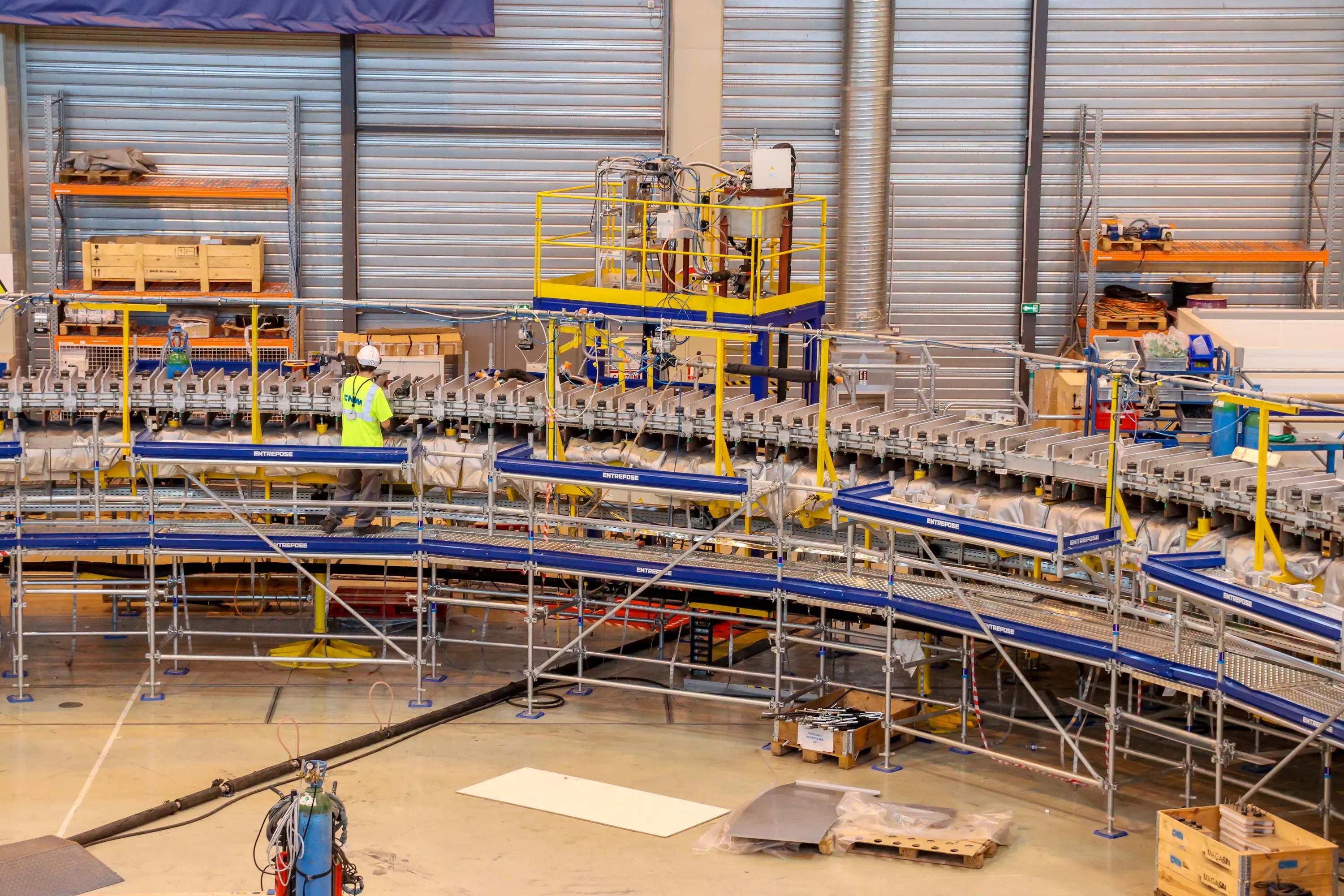
The photograph offers a surprisingly ordinary way into an extraordinary project. A worker in a high-visibility shirt stands on a metal platform beside a broad curve of machinery. Guardrails, decks and scaffold standards fill the foreground. This is poloidal field coil construction at ITER in August 2022, recorded by photographer Johannes Reimer. Before the magnets can become part of a fusion experiment, people need somewhere to stand.
That human-scale requirement runs through ITER’s construction history. The scientific ambition attracts the headlines, but a welder still has to reach a joint. A surveyor needs a usable position. An assembly team needs space to remove the tool that helped put a component in place. Temporary access helps make those tasks possible.
For the scaffolding industry, ITER is a revealing place to look. Its construction records show familiar equipment meeting unusual constraints, and the practical judgement involved in turning an ambitious design into work that people can actually perform.
Cover photograph: Poloidal field coil construction at ITER, 22 August 2022. Johannes Reimer / Wikimedia Commons, CC BY 4.0. Original photograph, not generated imagery; no edits to the supplied file. It shows coil construction, not the tokamak pit or the specific operations described below.
A fusion experiment with a construction problem
ITER is an international research project under construction at Saint-Paul-lez-Durance in southern France. Its central machine is a tokamak, which uses powerful magnetic fields to confine the hot plasma in which fusion reactions can occur. ITER is intended to investigate fusion’s scientific and technological feasibility; it will not convert its fusion heat into electricity for the grid. ITER overview
That distinction keeps the construction story in focus. A successful lift or a finished scaffold does not prove commercial fusion has arrived. It marks progress towards a machine with an experimental purpose.
Looking at that machine as a workplace brings a different set of questions into view. Where can someone stand? What needs to remain clear? Which temporary support is still needed, and which must come out before the next operation? These questions belong to construction, yet their answers help determine whether scientific hardware can be assembled at all.
This article follows documented examples from different years. It is a construction feature, not a report from a site visit, a live progress dashboard or technical guidance for reproducing any of the structures.
Long before the magnets, there was formwork
The temporary-works story began well before the recognisable machine appeared. In March 2013, ITER described propping and formwork being assembled for the Tokamak Complex’s B2 slab. The structures would carry reinforcement and fresh concrete until the hardened slab could transfer its load to the seismic supports beneath it. ITER, March 2013
For formwork readers, the sequence is familiar even when the project is exceptional. A drawing shows the finished concrete. Construction has to provide a reliable way to hold that concrete while it cannot yet do its permanent job.
There is something useful about seeing such a recognisable operation at a fusion research site. Innovation does not remove the need for ordinary construction disciplines. It gives those disciplines a demanding setting. The foundation of an advanced machine still depends on reinforcement, forms, supports and the people who understand how they fit together.
Rehearsing the difficult parts
Fusion for Energy, the organisation managing Europe’s contribution to ITER, reported a completed 150-square-metre construction mock-up in May 2013. It reproduced particularly difficult reinforcement arrangements and helped test the interfaces with embedded parts before work on the actual slab. Fusion for Energy, May 2013
A physical mock-up has a different value from a persuasive drawing. People can discover how a task feels when hands, tools and materials occupy the space together. Access that appears generous on a screen can become less generous once the work is physically assembled.
For the temporary-works sector, this is an appealing part of the story: practical experience had a place beside engineering models. The mock-up made room for questions that are easier to answer by doing. Its purpose was learning before committing to a much larger piece of construction, rather than pretending that complexity could be eliminated by description alone.
A building repeatedly revealed and concealed
In February 2018, ITER reported the removal of formwork, scaffolding and platforms from the bioshield, the large protective concrete structure surrounding the machine. Concrete pouring had begun in October 2015. While that structure was being uncovered, temporary works were going up for an adjacent reinforced wall. ITER, February 2018
It is a small detail with a larger visual meaning. Construction photographs often celebrate the moment a permanent structure is revealed. For the scaffold team, the same moment can mark a transfer of effort to somewhere else.
An industrial project is therefore better understood as a succession of changing workplaces than as one scaffold surrounding one finished object. A platform completes its assignment, disappears from a photograph and becomes available for another purpose. The permanent works accumulate. The access arrangements keep changing.
That movement can make temporary works easy to overlook in the final account, even when they were essential to getting there.
Five night shifts after months of preparation
A particularly clear example emerged in ITER’s April 2022 account of its scaffold operation. Upper-level access was needed on the first sector sub-assembly tool, known as SSAT#1. The site team and Entrepose Echafaudages designers coordinated a three-dimensional design over two months. The bespoke scaffold was erected during five night shifts in March, then inspected by Bureau Veritas before use. ITER, April 2022
That report also recorded approximately 800 scaffolds in use and more than 300 new scaffold jobs each month, excluding alteration and dismantling work. Those figures describe the 2022 site, not today’s inventory.
The visible work occupied five shifts; preparation took much longer. The brief construction window makes a useful reminder that design effort can be a large part of a scaffold’s value, even when clients see mainly installation labour.
The kit changed with the environment
Entrepose’s project account identifies a system developed for ITER called Crabinox. Derived from its Multicrab equipment, it combines a stainless-steel framework with aluminium decks for the project’s demanding material requirements. The supplier describes separate teams working in the machine’s core and around the surrounding plant. Its page is undated, so relative progress forecasts there should not be read as a November 2026 programme. Entrepose project account
The equipment is interesting because it shows adaptation happening at component level. A familiar modular approach can be retained while the material specification changes to suit its surroundings.
It also demands care with language. Special equipment for cleanliness-sensitive work is not evidence of an emissions-free manufacturing process. Material selection, contamination control and environmental performance are different subjects, even when the same word appears in discussions of them.
For a scaffold business, the worthwhile question is how clearly it understands the environment its equipment will enter. Suitability involves more than a platform’s dimensions.
Sometimes the right access is not a scaffold
ITER’s records also show a situation in which a scaffold was not yet an option. In June 2022, a sector module had not reached the stability needed for scaffold installation. Rope-access technicians placed targets for laser measurement instead. ITER, June 2022
The episode makes this a more interesting scaffolding story, rather than a less relevant one. A project can value the trade without using its equipment for every task. The appropriate access method depends on the condition of the work, the purpose of the intervention and the constraints at that moment.
It would be misleading to turn this one operation into a general recommendation for rope access. What it demonstrates is the importance of recognising when the expected arrangement does not fit the available conditions.
The professional skill lies partly in that recognition. An access specialist contributes judgement about the job, not simply a preferred inventory of components.
Repair created another temporary workplace
Construction does not always advance through a tidy series of first-time successes. In March 2024, ITER reported work to repair vacuum vessel sector 7. Nearly 20-metre-high scaffolding provided platforms at different levels for four welders. ITER, March 2024
This was repair during construction, not maintenance on an operating fusion reactor. That matters both to the chronology and to how readers interpret the image of people working around a major machine component.
The access requirement also reveals a quieter aspect of specialist construction. When the planned sequence changes, a usable workplace still has to be created for the work that now needs doing. Repair is often less photogenic than a major delivery or ceremonial milestone, but it can require just as much thought about where people and equipment belong.
A credible account of an ambitious project should leave room for this kind of work. Temporary structures support problem-solving as well as progress photographs.
Measurement gives the space a reference
ITER’s metrology programme provides another perspective on the workplace. Metrology is the science of measurement. The organisation describes survey networks, laser trackers, total stations and photogrammetry being used to control geometry and record the machine as it is actually assembled. ITER metrology overview
The important idea for a non-specialist reader is the difference between a design position and a measured position. Large components do not become correctly aligned because they look convincing in a photograph. Their locations have to be related to a reference system and checked.
Seen in that light, temporary access belongs to a carefully measured environment. A platform is a place for someone to work, but it also occupies space that another activity may need. The human view and the geometric view have to coexist.
This is one reason an industrial scaffold can be intellectually demanding without looking unusual from a distance. The visible tubes are only part of the problem.
Getting the temporary tools back out
An April 2026 report brings that relationship into sharp focus. Sector modules were held together during lifting by temporary bracing tools. Once a module was installed, those tools had to be disconnected and removed from the confined tokamak pit. ITER described scaffolding, rails, hoists and counterweight lifting tools being involved, with restricted clearances making scaffold positioning consequential. The report recorded removal of sector 7’s last brace on 13 April. ITER, April 2026
The compelling detail is that the challenge continued after the large component had arrived. Installation was not complete simply because the crane had delivered its load.
For temporary works, removal deserves its own attention. A structure can provide excellent access while occupying space that a departing tool needs. The next operation may therefore depend on how the temporary arrangement is positioned, altered or taken away.
Here, the exit route is part of the construction story. The work has to be understood forwards and backwards.
Thousands of small attachments inside a giant sector
In August 2026, Fusion for Energy described scaffolding being set up inside vacuum vessel sector 4 so welders could install more than 2,000 supports for diagnostic sensors and cables. Its account connected careful positioning with three-dimensional software, laser tools and skilled manual work. This is an August snapshot, not a claim that the same task remains underway in November. Fusion for Energy, August 2026
The number offers a useful counterweight to the giant components that dominate public images. A large machine also contains a great many smaller, repeated tasks. Each attachment has a location. Each location has to be reached.
For scaffolders, repetition does not necessarily make the work simple. The platform must suit the people performing the task and the surrounding geometry. The accumulated result comes from a long sequence of individual interventions, many too small to become a headline.
This is construction at the scale of a person’s reach, inside an object whose overall size can otherwise overwhelm the story.
The machine has a much larger neighbourhood
The tokamak is only one part of the installation. ITER’s March 2026 account of plant coordination describes cooling, power, ventilation and other connected services being fitted around it. The coordination team used three-dimensional models and time-based simulations to examine work sequences and potential clashes. Scaffolding, access routes and lifting arrangements were among the services that had to be coordinated. ITER, March 2026
This wider setting helps explain why a single spectacular scaffold cannot represent the whole access operation. The project contains many workplaces, occupied by different trades for different reasons.
One useful way to read an industrial construction photograph is to ask what sits outside its frame. Where did the materials come from? How does the next team enter? What must stay available while the visible task proceeds?
Those questions bring attention back to the less celebrated work of making a site usable. They also make the contribution of experienced scaffold teams easier to see.
What this story gives the scaffolding industry
ITER offers a persuasive answer to a familiar communication problem: how to explain scaffolding’s value to someone who sees only a temporary framework.
The most convincing explanation is often a specific task. A welder needs a working position. A measurement team needs access. A component has to pass through a constrained space. A temporary tool has to leave after doing its job. Describing the task makes the role of the scaffold intelligible without relying on exaggerated claims about productivity or savings.
There is a useful distinction between celebrating skilled work and borrowing the prestige of the project around it. A contractor does not need to claim responsibility for the success of fusion research to show that its contribution matters. The documented work is interesting enough on its own.
The same principle applies when smaller companies tell their own project stories. Show the constraint, the people and the work made possible. Explain what was actually delivered. Be precise about dates, scope and the boundaries of the claim. An honest account can be more memorable than a catalogue of superlatives.
Frequently Asked Questions
What is ITER, and does it generate electricity?
ITER is a fusion research project under construction in southern France. It is intended to test the scientific and technological feasibility of fusion and is not designed to supply electricity to the grid. Construction progress should not be confused with commercial power generation.
What makes the scaffolding work at ITER interesting?
The documented examples involve changing construction stages, cleanliness requirements, constrained working spaces and access around large scientific components. They show scaffolders contributing to practical assembly problems alongside designers, welders, measurement specialists and other trades.
Is Crabinox a claim about zero-carbon scaffolding?
No. Entrepose describes Crabinox as specialist equipment with a stainless-steel framework and aluminium decks for ITER’s material requirements. That description does not establish a carbon footprint or a zero-emissions production process.
Are the scaffold numbers in this article current?
The approximately 800 scaffolds and more than 300 monthly new jobs came from ITER’s April 2022 report. They are historical figures. Other examples are dated individually, including the April and August 2026 assembly reports.
Can these examples be used as scaffold design instructions?
No. They explain documented project work without supplying the design information needed to reproduce it. Access methods, temporary supports and lifting interfaces require competent project-specific design, assessment and approval.
A place for skilled hands
There is a temptation to tell the story of a major scientific machine through its biggest components alone. The construction record offers a more human view. People need to reach, measure, weld, inspect and remove things, and the temporary workplace changes with those needs.
That is what makes ITER an engaging scaffolding story. It connects an ambitious international experiment with a practical trade whose work is often absent from the finished picture.
The photograph at the beginning brings that relationship back to a comprehensible scale: one worker, one platform, a piece of equipment within reach. However large the ambition becomes, construction still has to make room for skilled hands.
CloudScaff has no stated project role or affiliation with ITER, Fusion for Energy, Entrepose Echafaudages or the other organisations mentioned. This independent feature is based on the linked public records, reviewed on 7 November 2026.