Article content
In June 2022, the crew at Glastonbury’s Pyramid Stage had an hour to change the screen before Paul McCartney’s headline set. Showforce’s account says the main LED screen came down in 24 minutes and the whole changeover was completed in 45. For the audience, the next performance could begin. For the people moving equipment, those minutes were a concentrated demonstration of what makes a festival work. Showforce’s 2022 case study
The stage looked familiar. The work behind it was constantly changing. That combination makes Glastonbury an unusually revealing story for the scaffolding and temporary-structures industry: a recognisable place assembled through many different trades, then adapted for one performance after another.
There was no Glastonbury Festival in 2026. The organisers confirm a fallow year and a return to Worthy Farm from 23 to 27 June 2027. This pause offers a useful moment to look at the construction beneath the spectacle, using documented projects from earlier festivals rather than pretending there is a live 2026 build to report. Glastonbury’s official information
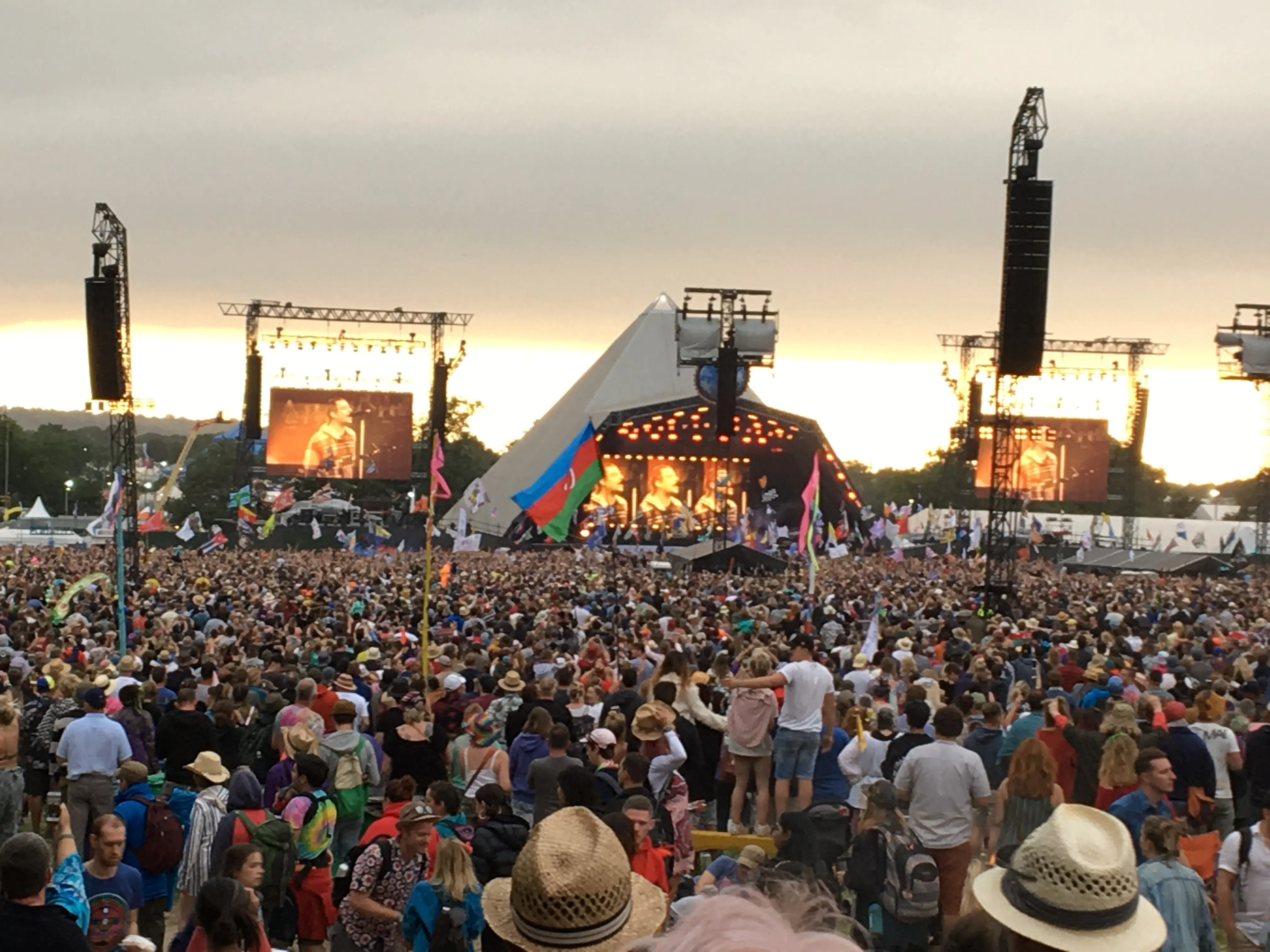
Cover photograph: Pyramid Stage during Glastonbury Festival 2019, by Rodw, 29 June 2019, CC BY-SA 4.0. Archival audience photograph, not a picture of the crews described. Original supplied unmodified; resized display versions remain under the same licence.
The Pyramid began with scaffolding
Glastonbury’s most recognisable structure began with a theatre designer and a crew using materials that scaffold contractors would recognise. The festival records that Bill Harkin’s 1971 Pyramid used scaffolding, expanded metal and plastic sheeting. Its distinctive outline made an ordinary set of construction materials into a place people could remember. The festival’s Pyramid history
That origin is worth dwelling on. Temporary equipment can carry an identity as well as a load. A silhouette, an opening and a clear focus for an audience can turn a collection of components into something that seems inseparable from an event. The first Pyramid’s significance did not depend on hiding every trace of how it was made.
The V&A’s account of the festival’s stage design explains another part of the effect: the Pyramid sits at the bottom of a hill, with the surrounding slopes forming a natural auditorium. The landscape helped give the stage its audience. Construction and geography were working together long before video screens became central to the experience. V&A: Glastonbury Festival stage design
In 1981, a more permanent Pyramid doubled as a winter cowshed and animal feed store. It burned down in 1994. The third incarnation, built in 2000 by Pilton resident Bill Burroughs, used a 30-metre steel structure with a 40-by-40-metre footprint. These are different structures with different histories, rather than one original scaffold endlessly patched and enlarged. Glastonbury’s account of the three Pyramids
The frame stays while the venue changes
The modern Pyramid is not dismantled to bare ground after every festival. A 2014 festival report about a charity abseil explicitly says its frame stays up throughout the year. Another official dispatch, from May 2013, records its covering being put back after the frame had stood bare since shortly after the 2011 festival. The year-round frame; the covering returning in 2013
That distinction makes the construction story more interesting. A standing frame is only part of a working venue. The festival version needs the equipment, platforms and supporting structures that turn a recognisable shape into a place where artists, technicians and audiences can spend several days together.
The building itself has also evolved. Structural engineer Momentum describes a roof redesign intended to increase its load-carrying capacity to 60 tonnes. The solution introduced frames and below-ground ties, allowing support towers to be removed and almost doubling the performance-space width while keeping the outer geometry. The firm’s public project page does not date the work, so it should not be presented as a new upgrade for an upcoming festival. Momentum’s Pyramid Stage project
For a spectator, continuity lives in the outline. For an engineer, continuity can include substantial changes inside it. The Pyramid demonstrates how a venue can preserve its visual character while making room for different production demands. The familiar view from the field is not a reliable guide to how much work has taken place behind the covering.
A stage needs a supporting neighbourhood
The temporary structures around the Pyramid help explain how much of a festival sits outside the frame of a television camera. Serious Stages’ account of Glastonbury’s 2022 anniversary edition records more than 60 site structures. Its work included screen and sound-system supports, delay towers, stage decks, camera towers, viewing platforms and a BBC studio. Those are dated supplier figures, not an inventory for 2025 or a forecast for 2027. Serious Stages’ 2022 project account
Each item serves a different person. A camera position gives a broadcaster a view. A sound-system tower helps an audio team reach people farther back. A platform creates usable space at a particular height. Seen together, these structures form a working neighbourhood around the performance rather than a single impressive roof.
The same 2022 account describes 17-metre delay towers in front of the Pyramid and bespoke decorative poles for the Park Stage, fabricated at the company’s Wells headquarters. The contrast is telling: some structures are there to support technical equipment, while others help give a festival area its visual character. Both belong in the construction story. Serious Stages on its different site structures
For scaffold and staging readers, this is the appeal of events work. A useful structure can sit in plain sight while its purpose remains almost invisible to the audience. People notice whether they can see, hear and move comfortably. The means of providing those experiences can disappear into the background precisely when they work well.
The people who keep the performance moving
The crew’s work continues after the venue opens. Showforce reports its own peak team of 67 at the 2022 Pyramid Stage, including crew managers, telehandler drivers and follow-spot operators. Teams supported audio, show calls and headliners. Its account describes a congested backstage area where one act could be leaving, another going on and the following artist loading in. Showforce’s crew and changeover account
This is a more useful picture of festival labour than an anonymous mass of people in high-visibility clothing. Different jobs happen in the same constrained space. The person driving a machine, the person positioning equipment and the person coordinating a changeover are contributing different skills to the same deadline.
The scale of the programme adds another layer. In its June 2025 announcement, Glastonbury described more than 3,000 performances across dozens of stages. It also announced a Wednesday-night Theatre & Circus show in the Pyramid arena, illustrating how a familiar location can serve different forms of performance. That announcement describes the programme, not a count of structures or crew. Glastonbury’s 2025 programme announcement
An audience reads that programme as a series of choices. The people making it happen have to think about places, equipment and transitions. The same field is simultaneously a cultural destination and a workplace.
The organiser’s workforce statement, dated April 2026, describes permanent staff in quieter months and a crew that expands through the festival cycle, combining direct employees, third-party workers and volunteers. These are different working arrangements, not one undifferentiated workforce. Giving the people behind an event proper attention means recognising those distinctions as well as celebrating the finished show. Glastonbury’s workforce statement
A local trade became a specialist business
Serious Stages traces its origins to Glastonbury and describes a business that now designs, fabricates and installs structures for events and film production. Its own account also explains that festival equipment travels around the UK and Ireland during the summer, being assembled, taken down and moved to another venue. The company presents reuse as a design intention across its components and structures. Serious Stages’ company account
A 2025 project report makes that travelling business concrete. While supplying stages for Glastonbury, Serious Stages says it was also delivering a Deftones concert at Crystal Palace and building a roof for the Silverstone Grand Prix concerts. The report describes overlapping commitments, not a single crew somehow working in three places or identical equipment on every site. Serious Stages’ June 2025 account
That history gives the story a commercial dimension without reducing it to a sales pitch. A temporary structure can represent a lasting investment in manufacturing, design knowledge and the people able to erect it. Its brief appearance in one field is only one episode in a longer working life.
It also helps explain why the word “temporary” can be misleading outside the industry. The show may last a weekend. The capability behind it takes much longer to develop. A company needs equipment that can travel and people who understand what changes from venue to venue. Repetition can build expertise, but each new setting still brings its own demands.
The result is a distinctive kind of construction business. Its finished work may vanish from the customer’s site on schedule, while much of the value remains with the contractor in reusable equipment, accumulated experience and specialist relationships. Glastonbury offers a particularly public view of that otherwise easily overlooked trade.
A giant head designed to come apart
Beyond the Pyramid, Glastonbury has commissioned structures with very different visual ambitions. In May 2019, the festival announced IICON as a new Block9 creation. It became an opportunity to turn a giant sculptural head into a performance setting. Glastonbury’s IICON announcement
Fabricator Illusion’s project account reveals the practical thinking beneath the spectacle. It describes a structure 20 metres high, 35 metres wide and 31 metres deep, made using plywood and steel formers beneath a sculpted finish. For transport and repeated use, the work was divided into 40 modular panels, packed in purpose-made stillages and shipped across seven 40-foot containers. Illusion’s IICON fabrication record
The important detail for the construction industry is the division into parts. An object intended to appear monumental had to be conceived as something that could be handled, packed and assembled. Its artistic effect and its transport logic were both design problems.
A stillage is a support or frame used to store and move equipment. It is hardly the most glamorous part of a festival sculpture, but its inclusion in the fabricator’s account says something about the work. The spectacle has a life before the public sees it and another after the lights go out.
This also puts a useful limit on the habit of calling every festival structure “scaffolding”. A site can combine scaffold access, engineered staging, trusses, scenic fabrication and permanent steelwork. They can cooperate without being interchangeable. IICON’s fabrication story should be appreciated for what its maker actually describes, rather than assigned a scaffold system that the public record does not identify.
The field is part of the engineering
A festival site brings the ground into the story. The UK Health and Safety Executive’s event-site guidance calls attention to ground conditions, topography, bearing capacity and the conditions at anchoring points. It also asks organisers to consider how a site responds to extreme weather, including flooding. These are general event-design principles, not a published assessment of any particular Glastonbury structure. HSE guidance on venue and site design
That guidance helps explain why a convincing festival photograph tells only part of the story. It shows the completed arrangement above ground. It cannot show the investigation, design decisions and coordination needed to make that arrangement appropriate for its location.
For the people building it, a field is a worksite with routes, interfaces and changing conditions. For the people arriving later, it becomes somewhere to meet friends and watch a show. Good event construction has to serve both versions of the place.
This is where the romantic language of spontaneous transformation can obscure real skill. The apparent ease of a festival setting depends on decisions that are often unphotogenic. A sensible delivery route or a properly planned working area will rarely become the event’s signature image. Their absence, however, would be felt by the people expected to work there.
The job continues after the audience leaves
Dismantling belongs to the main construction story. HSE’s work on temporary demountable structures, commissioned ahead of the London 2012 Games, explicitly considered both erection and deconstruction. Its published summary describes research into existing guidance, experience and industry practice, intended to support better safety standards. The return journey deserves the same attention as the opening. HSE’s temporary-structures research
Glastonbury’s own information also identifies a separate post-festival clear-up crew for the final litter pick. That work should not be confused with specialist structural dismantling, but it is another reminder that a festival’s finish looks different depending on whose job is being described. Glastonbury’s post-festival clear-up information
A spectator’s last song is not a contractor’s handover. Equipment must be recovered, the site made ready for its next use, and the people doing that work given the same consideration as those who built the show. The useful measure of a temporary project includes how it leaves.
Reuse also deserves careful language. A structure designed to travel again is a different proposition from a disposable set, but that fact alone does not establish a carbon saving. Transport, repair, energy and the number of useful deployments all matter to any serious comparison. The evidence here supports an account of reusable equipment and modular construction, not an invented environmental score.
Frequently Asked Questions
Is Glastonbury’s Pyramid Stage taken down every year?
The steel frame remains in place year-round, as the festival’s own historical reporting confirms. Its covering and the equipment and structures needed for a working festival are a separate part of the site’s preparation.
Was the original Pyramid Stage made from scaffolding?
Yes. Glastonbury records that Bill Harkin and his crew built the 1971 Pyramid using scaffolding, expanded metal and plastic sheeting. The present structure dates from a later incarnation, so the original materials should not be treated as a description of today’s entire stage.
What temporary structures support a major festival stage?
Documented Glastonbury work includes camera positions, sound-system towers, screen supports, stage decks and viewing platforms. Their designs and quantities depend on the particular event and year; one supplier’s historical inventory is not a current specification.
Does temporary mean the structure is disposable?
No. Event structures can be designed for repeated assembly and use. Serious Stages describes equipment travelling between venues, while Illusion documents modular panels and transport stillages for IICON; reuse still requires suitable design, care and planning.
When does Glastonbury return after its 2026 fallow year?
The organisers list 23–27 June 2027 as the next festival dates. Earlier crew numbers, stage configurations and project accounts in this article describe their stated years, not confirmed arrangements for that future edition.
Before the next headline set
Glastonbury’s construction story runs from Harkin’s scaffold Pyramid to travelling stage systems, adapted steelwork and sculptures that fit into containers. The continuity lies partly in the people who know how to turn an idea into a place where others can gather.
A fallow year leaves room to notice that work. When the next audience looks towards a stage, the most visible names will be the performers’. The experience will also depend on designers, fabricators, scaffolders, plant operators and production crews whose work made the view possible.
CloudScaff has no affiliation with Glastonbury Festival or the companies mentioned. This feature draws on linked public records and is not a site visit, interview or temporary-works design guide.