Article content
A Portuguese scaffolding manufacturer offers an unusually good vantage point from which to understand an Austrian construction group’s ambitions. In February 2026, umdasch Industrial Solutions announced that it had acquired Catari. The company being bought had begun as a metalworking business in 1979. Its manufacturing operation was now joining the same industrial division as AT-PAC. The acquisition announcement
For anyone who remembered the earlier headlines about Doka buying AT-PAC, there was an obvious question: where did this new industrial division fit? And why was a group so closely associated with concrete formwork buying another scaffolding manufacturer?
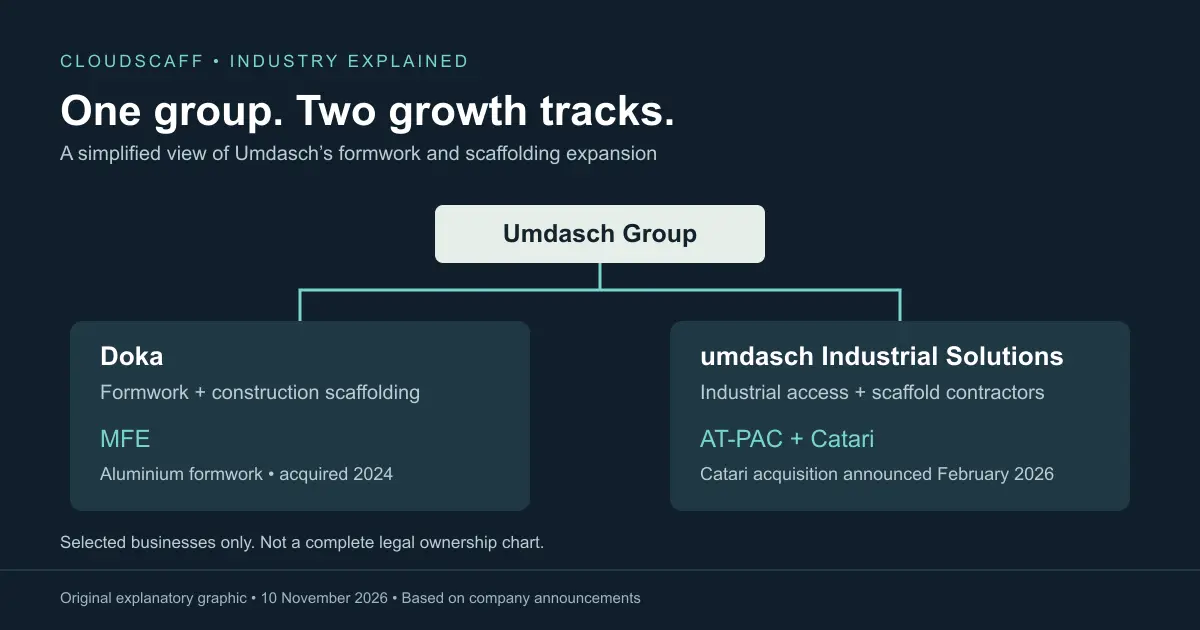
The answers lead beyond a simple story of a large supplier getting larger. There are two related growth tracks: one built around serving construction customers with a wider range of formwork and scaffolding, the other around industrial access and specialist scaffold contractors. Following both makes the acquisitions easier to understand, and raises some useful questions about how temporary-works suppliers compete.
This feature looks at developments verified as of 10 November 2026. The corporate events are sourced below. The discussion of their commercial significance is analysis, rather than a claim that the announced benefits have already been achieved.
The partnership before the ownership headlines
The starting point was a supply relationship. In November 2020, AT-PAC announced a strategic global partnership under which Doka would offer its Ringlock scaffold system and Hi-Vis technology. The announcement described a broader proposition for Doka’s customers: scaffolding alongside its established formwork offering. AT-PAC’s original announcement
That sequence matters. A commercial partnership gives two businesses a way to work together before full ownership brings them under the same corporate control. In this case, the relationship also joined two different customer conversations. A formwork supplier might be involved while a contractor is planning how to build a concrete structure. An access specialist might be dealing with how people will reach workfaces during construction or maintenance. The equipment can share a project without solving the same problem.
Doka announced a majority investment on 6 July 2022, then announced completion of full ownership on 2 February 2023. Those releases show that the group deepened its commitment in stages. The majority announcement and the full-acquisition announcement
Umdasch’s 2023 annual report records the increase in its AT-PAC participation from 60% to 100%. It is a more precise description than treating 2023 as the first contact between the businesses. Umdasch Group’s 2023 annual report
For an industry reader, the interesting development is the progression: establish a working relationship, deepen ownership, then decide how the expanded business should be organised. Each step answers a different question. Can the products be offered together? Should the business be fully owned? Which customers should each part concentrate on? Those questions can be lost when several years of development are compressed into a single acquisition headline.
Why a separate industrial division appeared
The next change was organisational. Umdasch Industrial Solutions launched on 1 January 2025. The group now lists it alongside Doka and umdasch The Store Makers as a directly affiliated division. AT-PAC’s April 2025 branding update confirms its position within UIS. Umdasch’s corporate history and AT-PAC’s transition announcement
A March 2025 ScaffMag interview with Doka CEO Robert Hauser and Industrial Solutions CEO Paolo Zumaglini explained the distinction: Doka would continue serving construction companies with formwork and scaffolding, while the new division focused on industrial customers and specialist scaffold businesses. ScaffMag’s interview
The 2024 annual report adds an important connection: UIS also supplies scaffolding to its sister company Doka. The structure separates customer focus while retaining a supply relationship between the divisions. It is therefore more nuanced than simply splitting formwork from scaffolding. Umdasch Group’s 2024 annual report
Read in that light, separating the businesses has a practical logic. Consider two hypothetical customers. One is a contractor building a concrete residential tower, looking for a coordinated proposal around its construction programme. The other is an access contractor supporting maintenance at an operating industrial facility. Both may need scaffolding, but the relationship they want with a supplier could differ in duration, technical support, equipment ownership and the way work is awarded.
A single group can serve both, but identical sales arrangements would not necessarily suit both. That is our interpretation of the structure, not evidence that every construction buyer or industrial contractor behaves the same way.
The distinction also prevents a common misunderstanding. A shared parent does not make the names interchangeable. Doka, AT-PAC and umdasch Industrial Solutions describe different parts of the story. A customer trying to understand who supplies, supports or contracts for a particular service needs the relevant local business, rather than a general statement about the group.
That may sound like corporate housekeeping. For the people buying equipment, however, it is often where a grand strategy becomes a real relationship: who answers a technical question, who holds the commercial agreement and who is responsible when a project changes?
Catari adds a manufacturing chapter
Catari brought a different dimension to the industrial division. The February announcement emphasised its automated manufacturing facilities, European presence and continued independent operation within UIS. It described stronger European production and a broader portfolio as reasons for the transaction. Those are the buyer’s stated aims; the release does not provide independently measured evidence of improved customer lead times or lower prices.
The manufacturing angle is worth pausing over. Opening a branch and acquiring a factory are different ways of expanding. A branch moves the customer interface closer to the market. A manufacturing operation adds production capabilities and the people who know how to use them. The two can complement each other, but neither automatically solves the other’s problems.
As commercial analysis, the Catari move suggests a group interested in more than putting another sales point on a map. Production knowledge, product development and existing regional relationships can be valuable alongside distribution. At the same time, integrating businesses with their own histories brings choices about where to standardise and where to preserve local expertise.
That tension is especially interesting in scaffolding. Customers may have long-standing relationships with particular people and confidence in a familiar product range. The acquisition announcement’s promise of continuity therefore deserves attention alongside its growth language. A larger owner has to make the additional resources useful without making the supplier harder to deal with.
There is no disclosed transaction price in the announcement reviewed for this feature. Nor does it establish market share or prove that the group has achieved a particular global ranking.
MFE follows the other track
On the formwork side, MFE provides a useful contrast. The Malaysian business traces its origins to 1991 and identifies its 2024 acquisition as the point at which it became a Doka company within Umdasch Group. Its specialism is aluminium formwork. MFE’s company history
The group’s 2023 annual report, in its subsequent-events discussion, records Doka’s acquisition of the MFE holding in January 2024. Public announcements followed in February. Keeping the transaction and announcement dates separate avoids making the chronology more definite than the evidence allows.
MFE illustrates why “growth through acquisition” is too broad a phrase to explain the strategy on its own. A supplier can acquire another business to extend its geographical reach, to add a manufacturing base, to bring in a different product family or to deepen technical expertise. Several of those motives can coexist, but the customer proposition still needs to be clear.
MFE’s September 2025 brand refresh offers a more tangible view of integration. It retained its own identity alongside Doka and presented its Malaysian facilities as part of the regional supply strategy. The company connected local production with shorter delivery distances; that is its stated rationale, rather than a measured saving established here. MFE’s brand announcement
Keeping a specialist name while linking it visibly to a larger owner is a different choice from absorbing everything under one label. It gives customers continuity in the product identity while making the wider relationship explicit. The manufacturing base matters too: the expansion includes capability in Asia, rather than only an enlarged catalogue sold from Europe.
For a hypothetical contractor comparing construction methods, the useful question is not how many brands sit under the parent company. It is whether the proposed system fits the building geometry, the planned repetition, the available workforce and the project’s engineering requirements. A broader portfolio can create more options. It does not, by itself, establish which option is right.
This is where a company-development story becomes relevant to people far beyond the companies making the deals. The industry is watching suppliers change the range of problems they want to solve. Customers still have to judge the quality of the particular answer offered to them.
A global ambition still needs local addresses
The industrial expansion has also produced identifiable local developments. AT-PAC’s UAE announcement gives 1 July 2026 as the official launch of its dedicated operation there, following earlier regional work alongside Doka. AT-PAC’s UAE launch
In Australia, the company announced a Darwin branch in June 2026, describing a local sales, rental and technical-support presence for the Northern Territory. The Darwin announcement
An Auckland branch announcement followed in August, after the New Zealand market had previously been served through Australian operations. The distinction between already serving a country and establishing a dedicated local base is an important part of this expansion. The Auckland announcement
Our reading is that the addresses are as important as the corporate diagram. Temporary equipment has to reach a project, and technical questions have to reach someone able to answer them. An international group can offer resources, but customers experience those resources through particular local teams and arrangements.
For readers in South Africa and elsewhere in Africa, these announcements are relevant evidence of the group’s direction, not proof of a new branch, stockholding or service promise in their own market. The same distinction applies to a contractor in the UK, Canada or another country: a neighbouring region’s announcement should not be converted into a local assumption.
The Americas supply another part of the picture. AT-PAC announced an Auburndale, Florida branch in May 2026, between Tampa and Orlando. Its stated customer groups included scaffold contractors, asset owners and engineering, procurement and construction businesses. Expansion was therefore also happening within an established home market, not just through new overseas operations. The Florida announcement
What this changes for an independent scaffold business
For a smaller scaffold company, a supplier’s acquisition can feel remote until it affects a familiar relationship. The most useful response is neither automatic enthusiasm nor the assumption that a larger group must be bad for independents. There are several possible outcomes, and the evidence has to catch up with the announcement.
A broader supplier might make specialist support more accessible. It might offer additional rental options or introduce products that were previously difficult to source locally. Equally, an independent business could find that its local service matters more than the scale of the parent group.
Imagine, hypothetically, an independent contractor that already owns a substantial fleet from one supplier. Its real concern after an ownership change may be the continued availability of particular components and technical documentation. Another contractor starting a new operation might value a wider package of equipment and support. Their reactions to the same acquisition could reasonably differ because their starting positions differ.
There is also a limit to what shared ownership tells either buyer. It does not establish that products from different brands can be mixed, that approvals transfer between systems or that rental and warranty terms are identical. Those matters require the relevant technical and contractual information. A corporate family tree is useful context, but it cannot serve as an engineering instruction.
The opportunity for independents is to look closely at the service they actually receive. Does the new structure improve access to knowledge? Is the local team easier to reach? Are commercial arrangements clear? These questions keep attention on the customer relationship without reducing an industry development to a generic checklist.
The harder part begins after the deal
Acquisitions are easy to date. The work that makes them worthwhile is harder to observe from outside. There is a signing or announcement; then there are decisions about people, product development, investment, distribution and how much independence to retain.
The two-track structure makes the Umdasch story particularly revealing. It suggests an attempt to keep different customer needs visible while building a larger group around them. That is an interpretation supported by the stated division of focus, rather than a verdict on its success.
Several questions remain open. Will the manufacturing and distribution investments translate into benefits customers can identify? Will the separate brands keep the expertise and relationships that made them worth acquiring? Will the wider group make it easier to solve difficult project problems, or will customers still experience each business largely as before?
Answering those questions would require evidence beyond company announcements: customer experiences, longer-term operating results and detailed regional information.
For now, the notable development is the shape of the expansion. MFE adds depth on the formwork side. AT-PAC provides an established scaffolding business within the industrial division. Catari adds another manufacturing and regional history. The result is more interesting than a collection of logos, because it shows different ideas about where future business might come from.
Frequently Asked Questions
Did Doka acquire AT-PAC in 2023?
Doka announced a majority investment on 6 July 2022, then announced completion of full ownership on 2 February 2023. Those releases show that the group deepened its commitment in stages. The majority announcement and the full-acquisition announcement
Umdasch’s 2023 annual report records the increase in AT-PAC ownership from 60% to 100%. The relationship already included the strategic supply partnership announced in 2020. Later organisational changes placed AT-PAC within umdasch Industrial Solutions, so the 2023 headline alone does not explain the current structure.
Is this a complete map of Umdasch Group?
No. The feature follows selected scaffolding and formwork developments. The cover diagram leaves out other group businesses and is not a legal ownership chart. Readers needing contractual or company-registration information should obtain it for the specific entity concerned.
Is MFE a scaffolding company in the same division?
MFE describes itself as an aluminium formwork business and a Doka company within Umdasch Group. It belongs to the formwork side of the story discussed here. Its acquisition should not be confused with Catari joining the industrial division.
Can customers combine equipment because the brands share a parent?
Shared ownership is not evidence of technical compatibility. Any proposed combination needs the appropriate manufacturer information and competent project-specific assessment. This article is a business feature and supplies no design approval, load capacity or permission to interchange components.
Do the announcements prove better service or lower prices?
No. They establish reported transactions, organisational changes and branch openings. Statements about intended benefits are identified as company aims. Demonstrating better service or lower prices would require additional evidence for the relevant products, contracts and local market.
Conclusion
Catari’s move into umdasch Industrial Solutions is a useful place to revisit a story that began well before 2026. The earlier Doka and AT-PAC partnership, full ownership, the creation of a dedicated industrial division and MFE’s arrival on the formwork side describe a sequence of choices about customers and capabilities.
For the wider scaffolding and formwork industry, the most interesting question is how those choices will be felt outside the boardroom. A larger group can assemble production, expertise and distribution across borders. Its reputation will still depend on the experience of the people designing, supplying and using the equipment on individual projects.
Sources
Sources accessed 10 November 2026. Corporate sources verify their own announcements; they are not independent audits of performance claims.
- umdasch Industrial Solutions: Catari acquisition, February 2026
- AT-PAC: strategic global partnership with Doka, November 2020
- Doka: majority investment announcement, July 2022
- Doka: full-acquisition announcement, February 2023
- Umdasch Group: Annual Report 2023, including subsequent events
- ScaffMag: interview with Robert Hauser and Paolo Zumaglini, March 2025
- Umdasch Group: current corporate structure and history
- AT-PAC: operating and branding transition, April 2025
- Umdasch Group: Annual Report 2024
- MFE: company history
- MFE: brand refresh, September 2025
- AT-PAC: Florida branch, May 2026
- AT-PAC: UAE official launch, July 2026
- AT-PAC: Darwin branch, June 2026
- AT-PAC: Auckland branch, August 2026
Cover: Original CloudScaff explanatory graphic, created for this article. It shows selected businesses and is not a complete legal ownership chart or a photograph of a project. No third-party logos or photographs are reproduced.