Article content
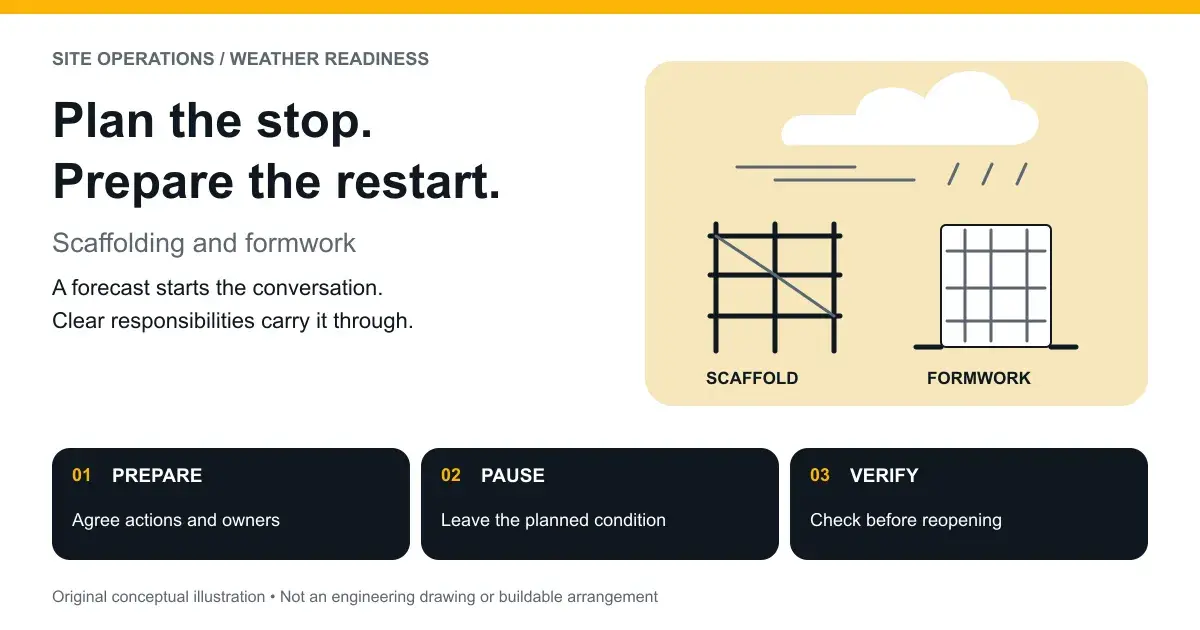
A useful weather plan explains how work will stop and how each affected area will reopen. A forecast alone cannot do either job. The scaffold team may need to restrict access, the formwork team may be between construction stages, and the concrete contractor may already have a delivery booked. Someone has to connect those decisions before worsening conditions force an improvised response.
For scaffolding and formwork businesses, the operational challenge extends beyond the hours when people are working. What condition will the installation be left in? Who receives an updated warning after the day shift leaves? Which activities remain restricted when the weather improves? Answering those questions makes the plan useful to supervisors, specialist contractors, security staff and the next crew through the gate.
This article offers a coordination framework for wind, heavy rain and storms. It supplies no wind-speed limit, structural design, bracing arrangement or permission to work. Project-specific engineering, manufacturer instructions, competent assessment and applicable local requirements govern those decisions. Regulatory examples are labelled by jurisdiction and were checked on 30 October 2026; the proposed briefing tools are editorial recommendations, not a universal legal checklist.
Separate the forecast, the work decision and the condition of the installation
Weather readiness works better when three questions receive separate answers: what is expected, what work can proceed, and what condition the temporary works must remain in.
A forecast informs planning. The decision to erect, lift, pour, inspect or use a particular area belongs within the project's authorised arrangements. The condition in which a scaffold or formwork installation can safely remain during a shutdown is a further technical question. Agreement to stop a task does not, by itself, resolve that condition.
This distinction matters when several firms share a site. A crane operation might be suspended while other activities are still being assessed. A scaffold may remain closed after the rain stops because an inspection or investigation is outstanding. A concrete placement may need to be rescheduled even though pedestrian access elsewhere has reopened. Treating all of these as one site-wide “weather status” hides information people need.
Use a small list of affected areas and activities. For each, identify the current restriction, its owner and the evidence needed to change it. An entry such as “east elevation scaffold: no user access pending specified inspection” is more useful than “weather delay”. It explains what the restriction covers and prevents an unrelated reopening decision from being mistaken for permission to enter.
Read the warning details, then connect them to the programme
Read the geographical area, timing and stated impacts of an official warning, rather than relying on its colour or a screenshot passed between phones. The UK Met Office explains that its warning colours combine expected impact with likelihood; yellow and amber each cover a range of situations. That is a description of the UK warning system, not an international classification for construction work. Met Office weather warnings guide
For a project elsewhere, use the relevant local meteorological authority and understand its terminology. Record when the information was issued and when it was last checked. A saved forecast is evidence of what was available at a particular time; it is not a promise about the next shift.
Then compare the forecast window with the planned activities. Ask when the installation will be part complete, when materials will be arriving, when people will be working in exposed locations and when specialist supervision will be available. The useful output is a set of decisions and review times, not another weather chart.
Make the source of any operating criterion clear. A public forecast, a local observation and a limit in equipment instructions are different pieces of information. The relevant specialist should establish how they are used for the actual operation. Do not copy a wind limit from another contractor's checklist or assume that a number used for one machine governs scaffold use, panel handling and concrete pumping alike.
Adapt the briefing to the project's country and season
An international contractor can reuse the questions in its weather briefing, but each project needs local answers. Confirm the official information source, the area and period covered, the language understood by the crews and the people authorised to make technical decisions. Build the review calendar around the project's actual season, exposure and construction stages. Copying a northern-hemisphere winter checklist into every programme can leave the wrong preparation dates and hazards in view.
For South African projects, the government's 26 August 2024 explanation describes SAWS warnings based on expected impacts. Use the locally issued details to ask which work areas, routes and planned activities need attention; a forwarded colour alone is insufficient context. South African Government explanation Elsewhere in Africa, establish the country's own sources. For example, the Kenya Meteorological Department provides county forecasts alongside daily forecasts and weather warnings. KMD forecasting services A hypothetical contractor moving a crew between Kenyan counties should brief the destination project from the relevant local information, including its delivery route and inspection contacts, rather than carry over yesterday's briefing from another site.
For European projects across national borders, EUMETNET describes MeteoAlarm as a common platform for warnings from national meteorological services, with multilingual information. EUMETNET's March 2025 explanation A portfolio manager can use that overview to identify projects needing follow-up, then check the issuing service's details with each site. Translate the resulting work instruction for the actual crews and retain its location, timing and owner. A common warning portal does not provide a common scaffold inspection rule or identify who may release a particular formwork operation.
For a UAE project, the National Center of Meteorology provides an official warnings-map service. NCM warnings map Use the applicable local information to review the actual work interfaces, not an assumed description of “Middle Eastern weather”. In a hypothetical project where a warning identifies reduced visibility or rain affecting the approach route, review delivery coordination and access alongside the exposed scaffold and formwork activities. If the site cannot retrieve current information, follow its agreed escalation arrangement. Neither an empty map display nor a screenshot without its timing establishes permission to proceed.
For Singapore, the Meteorological Service's lightning display illustrates why the product legend matters: icon colours indicate how recently lightning was detected. They are not interchangeable with another country's warning colours. MSS lightning information The project briefing should identify who monitors the agreed service and how the information reaches people handling panels, accessing platforms or coordinating a pour. The site-specific lightning procedure still determines the response; a map should not be improvised into an evacuation distance or restart timer.
For Canada, Environment and Climate Change Canada's explanation, modified 16 October 2026, explicitly distinguishes a thunderstorm outlook from an alert. ECCC thunderstorm outlook guide Use that distinction when assigning actions: an outlook can prompt an early coordination review, while current alerts, observations and applicable operating instructions inform the responsible team's decisions. Across all these examples, name the local scaffold, formwork and concrete-operation contacts before a weather interruption. Headquarters can coordinate resources, but it cannot infer technical acceptance from a country label, a colour or another project's reopening.
Work backwards from the planned stopping condition
Allow time to reach the agreed stopping condition while the work needed to get there can still be carried out safely. “We will stop when it gets bad” leaves the essential preparation undecided.
Ask the responsible scaffold or formwork contractor what the authorised sequence requires if work ends earlier than expected. Does the current information cover the stage likely to exist at shutdown? What needs to be referred to the designer or supplier? Which activities must be completed, postponed or avoided under the approved method? These questions request a planned condition; they do not tell a crew how to stabilise a structure.
A supervisor can turn the answers into a short briefing:
- Identify the work areas and the activities covered by the briefing.
- Name the current method, instructions and relevant design references.
- Confirm who decides when preparation begins and when work stops.
- Identify the planned stopping condition and any unresolved technical question.
- Explain the access restrictions, communication route and arrangements for withdrawal.
- Name the person who receives the handover when the current supervisor leaves.
Include the time needed to communicate with other trades. A delivery driver should not discover that a loading area is unavailable only after arriving at the gate. Security needs the current restriction and escalation contact, rather than a request to decide whether the installation looks safe. A night shift needs the same information in a form it can understand without reconstructing the day's conversations.
If conditions deteriorate before the planned preparation is complete, use the site's emergency arrangements and competent escalation route. Do not send people into an unsafe area to finish a checklist, secure a loose item or obtain a photograph. The plan needs a response to an incomplete shutdown as well as an orderly one.
Address scaffold use and weather protection explicitly
For scaffolds, the weather discussion needs to distinguish use of the platform from the actions required of the scaffold contractor. A user spotting an issue can report it and follow the site's access controls; that does not authorise the user to alter the scaffold.
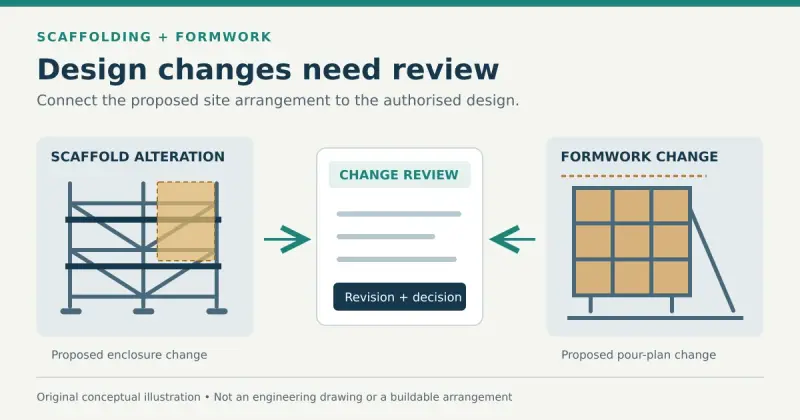
Great Britain's HSE says that those responsible for design and erection must be informed before sheeting or debris netting is added, so they can ensure the scaffold is designed for it. Its guidance also calls for inspection following circumstances liable to jeopardise safety, including high winds. Adding protection against the weather and checking after an event are therefore separate questions. HSE scaffolds guidance
Avoid leaving weather protection to a last-minute site request. If a work package needs an enclosure, establish the applicable arrangement and responsibilities through the authorised technical process. Equally, do not assume that cutting, loosening or removing an existing covering is an acceptable response to a forecast. Obtain the appropriate instructions before work is undertaken.
For US federal construction work, 29 CFR 1926.451(f)(12) prohibits work on or from scaffolds during storms or high winds unless a competent person determines it is safe and workers have the specified personal fall-arrest or wind-screen protection. Wind screens themselves require the scaffold to be secured against the anticipated wind forces. Paragraph (f)(3) separately requires competent-person inspections before each shift and after an occurrence that could affect structural integrity. These provisions do not establish a universal wind-speed threshold. OSHA scaffold requirements
The practical briefing should tell scaffold users where to obtain the current decision and how to report changed conditions. A generic statement that the scaffold was handed over previously cannot answer a new weather-related concern.
Give formwork its own weather preparation discussion
Formwork work has stages that do not fit neatly into “in use” and “not in use”. Panels may be erected before a pour, a deck may be ready for another trade, or supports may remain while the concrete and construction sequence are being assessed. Identify the actual stage when planning a pause.
Safe Work Australia's Guide to formwork, dated July 2014, says wall and column forms should be designed for wind loading before, during and after concrete placement. This is national guidance, not a statement that every Australian jurisdiction has identical legal provisions. The relevant lesson for planning is to obtain the instructions for the stage that will remain on site. Guide to formwork
Bring the formwork contractor, concrete contractor and relevant technical leads into the same discussion early enough to affect the programme. Ask whether the planned activity has an agreed stopping arrangement and what decisions are needed if the weather window changes. Any decision about interrupting placement, construction joints, concrete acceptance or subsequent support belongs with the responsible project specialists. A delivery booking cannot settle it.
The equipment around a pour also matters. Safe Work Australia's November 2021 concrete-pumping guide identifies wind effects on placing booms, rain-related changes in supporting ground and lightning exposure during storms. Checking the formwork does not replace the pumping contractor's assessment of its own operation. Concrete-pumping guidance
Use the coordination meeting to resolve interfaces rather than to invent a common limit. Who tells the pump supplier that the placement is deferred? Who confirms the next inspection and attendance arrangements? Who tells follow-on trades that the deck is unavailable? If a revised programme is proposed, who checks that it remains consistent with the authorised construction information?
Include supporting conditions in the review after rain
A weather review needs to consider the conditions around and beneath the installation, as well as what is visible at working level. Safe Work Australia's July 2014 General guide for formwork and falsework addresses wind and rain in foundation planning and identifies water and nearby excavation as potential causes of ground subsidence. Its advice supports referring changed supporting conditions for competent assessment; it does not provide a repair detail for a particular site. General guide for formwork and falsework
For the supervisor, an actionable observation identifies a place and a change. “Water is now collecting beside the support area shown on the marked plan” gives the reviewer more to work with than “ground looks wet”. Record observations from a safe position and state what could not be seen. Do not enter an excluded area to improve the record.
Keep the observation separate from its interpretation. A photograph can show water, debris or an apparent movement; it cannot certify bearing capacity or confirm that hidden conditions are unchanged. The appointed specialist decides what further information, access or assessment is needed. If that decision is outstanding, retain the relevant restriction and tell the people affected.
Make responsibility survive the shift change
Assign named people to the coordination tasks, with a deputy or escalation route when they are unavailable. A role title is useful, but a weekend call needs a person who knows the installation and can act within the project's arrangements.
The weather plan should make clear who monitors updates, who coordinates the work decision, who communicates closures and who arranges the required technical review or inspection. These may be different people. None of those administrative assignments transfers statutory duties or makes an unqualified person competent to inspect or design.
Test the contact arrangement with an ordinary scenario: a new warning arrives after the site manager has left, while another contractor is due to start early the next morning. Who receives it? Who decides whether the existing plan needs review? How does the arriving crew learn the current restriction before entering the work area?
Choose a communication method suited to the people receiving it. Where several languages are used, check that the restriction and contact route are understood. Where reception is unreliable, agree a practical alternative in advance. A message sent to a group is less useful than a confirmed briefing to the supervisor who controls the affected work.
Hypothetical example: a refurbishment scaffold over a working entrance
Consider a refurbishment project where an access scaffold serves an occupied building. Strong winds are forecast overnight, and the entrance below is normally opened by a facilities team before construction staff arrive. This is an illustrative scenario, not a report of an actual customer or site.
The principal contractor brings together the scaffold contractor, site supervisor and building representative. They identify the affected scaffold, the approved arrangements for the forecast conditions and the decisions still needed. The briefing separates construction access from the building entrance: the facilities team must know what applies to its route, not merely that scaffold work has stopped.
Before the day shift leaves, the responsible parties confirm the planned stopping condition and communicate the access restrictions. They identify who will receive overnight information and who will arrange any required inspection. Security receives the escalation contact and clear instructions on the current controls. It is not asked to assess scaffold stability during a patrol.
The following morning, the forecast has improved, but the agreed inspection has not yet taken place. The reopening decision remains with the authorised process. A building user wanting access and a trade contractor wanting to recover lost time receive the same current information about the affected area.
The useful result of this planning is clarity about the unresolved decision. Nobody needs to infer permission from the quieter weather or from another entrance being open. The example assumes no engineering outcome: inspection may support reopening, identify restrictions or lead to further review.
Hypothetical example: rain before a planned concrete placement
On a separate project, a concrete placement is scheduled after a period of heavy rain. Formwork is erected, the pumping contractor is booked and other trades expect access later that day. The supervisor receives a report of changed conditions near part of the work area.
The project team identifies exactly which operation and location are affected. It obtains the required assessment of the reported condition and confirms the formwork and pumping checks through their respective responsible parties. The concrete contractor contacts the supplier about the booking while the technical decision is pending. That commercial conversation does not authorise the pour.
For US federal construction work, 29 CFR 1926.703(b)(3) requires erected shoring to be inspected immediately before, during and immediately after concrete placement. A weather-related postponement should therefore be coordinated with the actual placement and inspection arrangements, rather than treating an earlier booking as the relevant event. OSHA cast-in-place concrete requirements
In this hypothetical project, the team records what remains unresolved, who is obtaining the evidence and when the programme will be reviewed. It tells follow-on trades which access or work expectations have changed. If a different sequence is proposed, that proposal follows the project's technical review procedure before implementation.
No conclusion about the foundation, pump setup or formwork adequacy is assumed here. The point is to keep the assessment, supply booking, inspection attendance and trade communication aligned. Otherwise, each participant can act on a different version of what “ready for the pour” means.
Reopen a defined area for a defined activity
Restart with a specific question: what evidence is needed before this area can be used for this activity? A general instruction to “check the site” does not identify the responsible reviewer or the condition being accepted.
Agree safe access for the necessary inspection or assessment before anyone enters. Distinguish access for authorised recovery or examination from access for ordinary production work. A closed area does not become open to all users because a specialist has been permitted to enter it.
A practical restart record can identify:
- The area, installation and proposed activity covered by the decision.
- The weather event or observation that prompted the restriction.
- The inspection or assessment references and the people responsible.
- Findings requiring action, with their current status and owner.
- Any continuing limitation, exclusion or review requirement.
- Who communicates the release decision and briefs the affected crews.
Avoid a signature that is broader than the evidence behind it. Releasing one scaffold elevation does not automatically release another. Accepting access for a formwork task does not necessarily confirm readiness for concrete placement. Make these boundaries visible in the briefing and at the relevant work interface.
If the inspection identifies damage or an unresolved concern, use the authorised response. Do not treat a restart form as pressure to complete every box with a positive answer. A clear record that an area remains unavailable is a useful operational result.
Keep the commercial record factual and proportionate
Record when the affected activity was planned, when the restriction began, what information prompted the decision and what work was actually affected. Note the resources or deliveries rescheduled and the communications made. These facts help the project team understand the event without claiming that every lost hour has the same cause.
Separate safety decisions from contractual entitlement. A weather warning does not itself establish who pays for a delay, and this article does not interpret any contract. The commercial team should follow the applicable notice and record requirements while the site team maintains the necessary controls. Avoid retrospectively changing a safety record to support a preferred commercial explanation.
For teams using CloudScaff, review the scaffold management and site management workflows, then agree where the current weather instruction and supporting project records belong in the workflow you already use. Make the authoritative record and its owner clear to everyone who needs it. A software entry can communicate a decision; it does not supply an engineering assessment, replace an inspection or grant permission to reopen an area.
After the event, review the coordination rather than merely archiving the warning. Was the contact available? Did the next shift receive the restriction? Was the inspection arranged at the right time? Were bookings changed before people and equipment arrived? Use the answers to improve the next briefing, without inventing a savings figure or treating one uneventful shutdown as proof of structural adequacy.
Frequently Asked Questions
Is there one wind speed at which all scaffold and formwork work must stop?
No single limit in this article applies to every installation or activity. Use the applicable law, project-specific engineering, manufacturer instructions and competent assessment; do not transfer a limit from unrelated equipment or a different task.
Can work restart when the weather warning ends?
The end of a warning is only one piece of information. Restart depends on the affected area's condition, the required inspections or assessments, any unresolved findings and the authorised decision for the intended activity.
Can a crew add or remove scaffold sheeting to prepare for a storm?
Only follow the authorised technical instructions and method for the installation. Do not improvise changes to sheeting, netting or other attachments because bad weather is approaching; refer the proposal to the responsible scaffold contractor and technical lead.
What should a supervisor record after heavy rain?
Record the location, observed change, time, affected activity and person notified, using information obtained safely. State what remains unknown and retain the relevant restriction until the responsible person has resolved it; photographs do not certify structural adequacy.
Does a weather plan replace scaffold or formwork inspections?
No. The plan coordinates actions, responsibilities and communication, while the applicable inspection and technical requirements still apply. It should identify who arranges those checks and how their findings reach the people deciding whether work can resume.
Make the next weather decision easier
Before the next forecast disrupts the programme, choose one scaffold area and one formwork operation and walk through the stopping and reopening arrangements with their responsible teams. Resolve the missing contact, unclear stopping stage or undefined release decision while there is time to do so. Weather readiness becomes practical when the people on the next shift can understand exactly what is permitted, what remains restricted and who owns the next decision.
For related planning, read why regular scaffold inspections matter. To discuss how these records fit your business, book a CloudScaff demo.
Sources and scope
Primary sources checked on 30 October 2026. These are selected jurisdiction examples, not a complete statement of the rules in every country. US state-plan provisions and Australian state or territory requirements require local checking; HSE guidance cited here concerns Great Britain.
- United Kingdom meteorological guidance: Met Office, Weather warnings guide, current online explanation of impact and likelihood; not a construction operating standard.
- Great Britain: HSE, Scaffolds, current online guidance on sheeting, access and inspection after circumstances that may jeopardise safety.
- United States, federal construction standard: OSHA, 29 CFR 1926.451, particularly paragraphs (f)(3) and (f)(12), current online text.
- Australia, national guidance: Safe Work Australia, Guide to formwork, July 2014, page 3, wall and column forms. The PDF date is retained rather than presenting it as a 2026 edition.
- Australia, national guidance: Safe Work Australia, General guide for formwork and falsework, July 2014, pages 9 and 13, foundations and ground conditions.
- Australia, national guidance: Safe Work Australia, Guide to managing risk in construction: Concrete pumping, November 2021, page 13, weather-related hazards.
- United States, federal construction standard: OSHA, 29 CFR 1926.703, particularly paragraph (b)(3), erected shoring inspection in relation to concrete placement, current online text.
- South Africa, warning-system explanation: South African Government, National Consultative Workshop address, 26 August 2024, describes SAWS impact-based warnings; not construction law or a current weather bulletin.
- Kenya, meteorological services: Kenya Meteorological Department, Weather forecasting, current service descriptions for county and daily forecasts and warnings; no active forecast reproduced.
- Europe, meteorological coordination: EUMETNET, Focus of the month, March 2025, MeteoAlarm's national-service and multilingual warning role; not a common construction regime.
- United Arab Emirates, meteorological service: National Center of Meteorology, Warnings map, official service entry point; no claim about active warnings, map completeness or construction limits.
- Singapore, meteorological information: Meteorological Service Singapore, Lightning Information Service, current legend and user information; no operating radius, evacuation distance or restart interval inferred.
- Canada, meteorological explanation: Environment and Climate Change Canada, Understanding Thunderstorm Outlooks, modified 16 October 2026, distinguishes an outlook from an alert; no active forecast or provincial construction rule inferred.