Article content
At Switzerland’s Valnit Bridge, the crews can’t prop up the 96-metre central span from the reservoir floor. In November, contractor Pizzarotti reported that form travellers were in use over the water, carrying the moulds for the next section of bridge from the concrete already built.
The bridge is going up at Airolo, at the southern end of the Gotthard road tunnel. It will carry ramps for the redesigned motorway junction, part of the Swiss Federal Roads Office’s second-tunnel project. The tunnel is the headline act, but out over the reservoir the bridge has its own puzzle: the concrete has to be held up while it hardens, and the obvious place to put temporary supports is off limits.
The reservoir changes the way the bridge is built
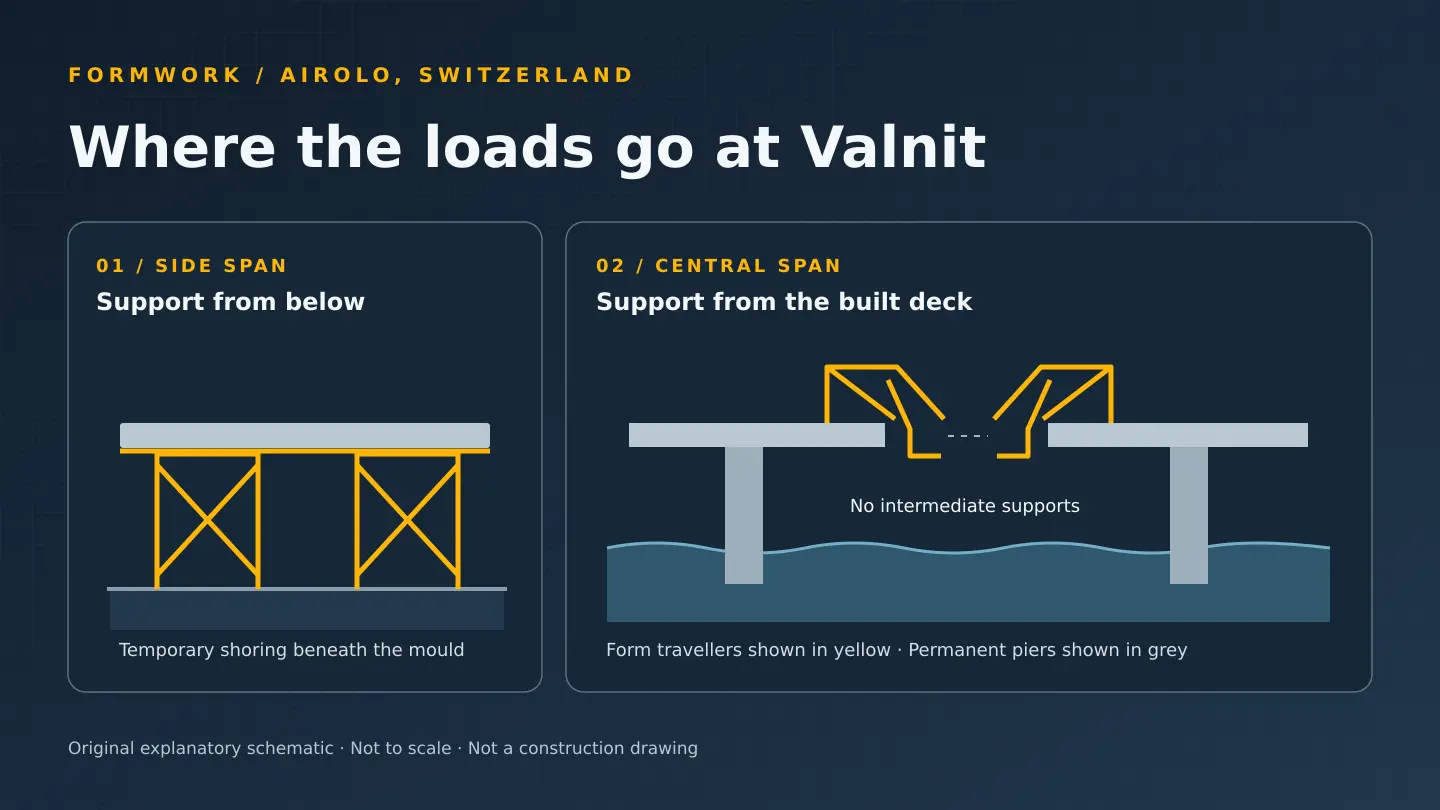
The Valnit Bridge curves in plan and changes width and depth along its length. The bridge designer describes a roughly 250-metre bridge with a hollow concrete deck. The side spans could be built on falsework, the temporary structure that holds the formwork and fresh concrete up. The central span needed a different approach. PERI explains that foundations for temporary supports beneath it could damage the reservoir’s waterproofing.
That distinction matters. The bridge still has permanent piers. What it doesn’t need is a row of intermediate temporary supports beneath the deck as the crews build out across the water. A form traveller is a movable frame that supports the mould and working platform for a new section. It takes support from the part of the bridge the crew has already built. Once the new concrete is ready to take its part in the structure, the traveller can move on. In balanced cantilever construction, crews work out from a pier in opposite directions so the two arms broadly counterbalance each other as they grow.
Some of the shoring stayed when the moulds came down
The side spans have their own story. A curved deck with changing widths is awkward to build with one repeated mould. PERI combined standard formwork and shoring with custom brackets and adapted the forms on site. It also reported that the two work areas were separated, with limited room to store gear, assemble it or get a crane into position.
The most interesting detail for a formwork firm is what happened to the towers. PERI says they took concreting loads during the side-span work. Instead of returning them with the other equipment, the team kept them and fitted them with hydraulic cylinders for the later phase. The supplier says reuse reduced the overall quantity of equipment needed, without publishing a figure for the saving. These were retained pieces of temporary works, not new supports dropped into the reservoir under the middle of the span.
For a contractor pricing similar work, that changes the meaning of the hire period. A set of towers can stop doing its first job and still be committed to the same bridge. On a tight site, leaving those towers where the next phase needs them may make more sense than taking them out and mobilising a fresh set later. That’s the commercial read on the decision, not a claim about the Valnit contract or its costs.
Where the work stood in November
In its 3 November progress report, Pizzarotti said the two trough sections on the north side had been poured and work had started on reinforcement and forms for the projecting edges of the deck. On the south side, the contractor reported that concrete placement for the trough and side deck was complete and that the lower tendons had been tensioned. The same update describes form travellers in use for the central span. It does not report that the span has closed or that the bridge is open.
The reservoir made it impossible to use the same support strategy across the site. What makes Valnit worth following is the middle ground the team found: build off the deck where there can’t be temporary supports below, and hang on to some of the equipment that still has a job where supports are possible.
FAQs
How does a form traveller differ from the shoring towers?
A form traveller carries the formwork and moves with the work. On the Valnit central span it relies on the deck already built. The conventional falsework supporting the side spans works up from below.
Is the Valnit Bridge part of the Gotthard tunnel itself?
No. The bridge carries motorway access ramps at Airolo. Rebuilding that junction is part of the wider road project for the second Gotthard tube.