Article content
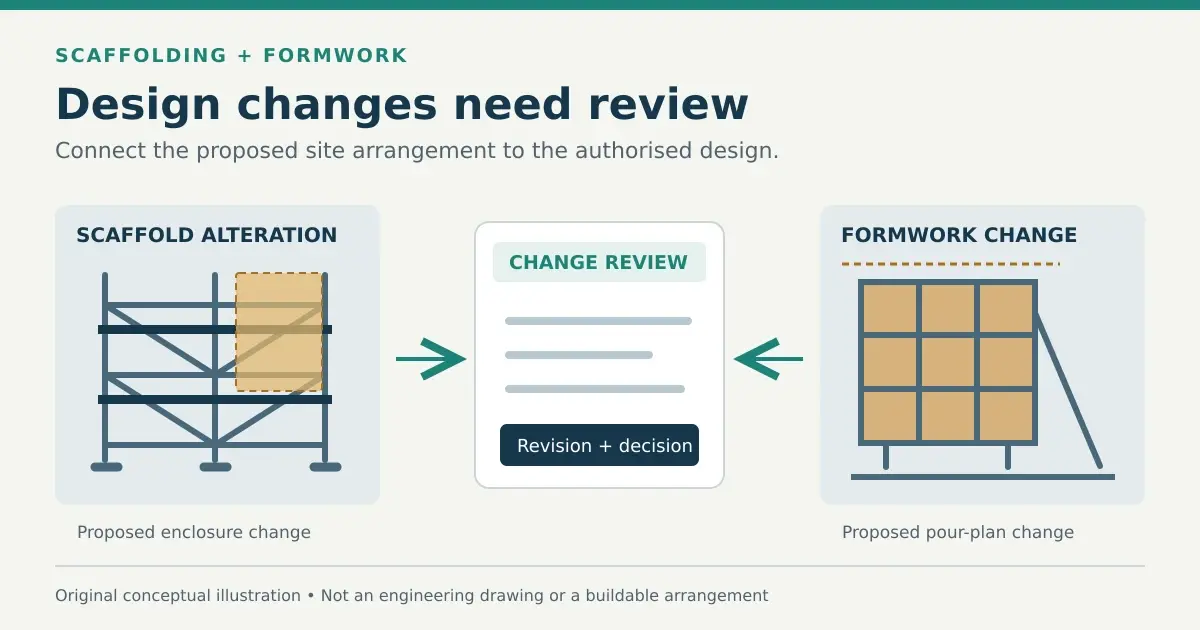
A façade contractor needs an obstruction moved before the afternoon shift. A concrete team wants to change the order of tomorrow's pours. Both requests sound like programme adjustments. Each may also change the conditions on which temporary works were designed.
The useful question is not simply whether the proposed work is small. It is whether the existing design still covers the arrangement, loading, sequence and conditions that will exist after the change, including the intermediate stages needed to get there.
This article sets out a practical way to ask that question across scaffolding and formwork packages. It is aimed at project managers, supervisors and operations teams who must get the right information to the right technical decision-maker. It does not provide a design, an alteration method, concrete-strength criteria or permission to proceed. Competent designers, manufacturer instructions, applicable law and the project's approved procedures govern those decisions.
The examples below are hypothetical. Regulatory references were checked on 29 October 2026 and are labelled by jurisdiction. The proposed management approach is editorial guidance, not a universal compliance checklist.
Establish what the existing design actually covers
Before discussing a change, identify the approved arrangement and its intended use. A drawing number alone may not answer that question. The design package can also include a specification, manufacturer instructions, calculations, an assembly sequence, use restrictions and assumptions supplied by other designers.
For a scaffold, ask which configuration and activities the design covers. Does it allow the proposed enclosure? What restrictions apply to loading, access and attachments? Which supporting structure and tie locations were assumed? For formwork and falsework, ask what concrete placement sequence, supporting arrangement and stages of loading were considered. Which conditions govern removal or reuse of supports?
These are requests for the relevant design information, not invitations for a supervisor to calculate a new solution. If the approved basis cannot be established, the uncertainty itself needs to go to the appointed technical lead before the affected work proceeds.
It also helps to distinguish the permanent structure from the temporary systems supporting or providing access to it. A revised permanent-works drawing can be an input to temporary-works design without being a revised temporary-works design. The person issuing a new wall opening, slab detail or construction joint should not assume every affected temporary arrangement has automatically been reassessed.
In the UK standards context, BSI identifies BS 5975-1:2024 as procedural guidance for managing temporary works and BS 5975-2:2024 as falsework design and implementation guidance. Together they replace BS 5975:2019. That distinction is useful: managing the review and performing the engineering review are related responsibilities, but they are not interchangeable. BSI catalogue
Recognise changes before they become physical alterations
A change can begin with a new use rather than a person removing equipment. A platform originally intended for one activity may be requested as a storage area. An un-sheeted scaffold may be expected to provide weather protection. A new delivery route may bring vehicles closer to supports. None of these requests should disappear into a general instruction to “make it work”.
For scaffolding, useful review triggers include proposed changes to the enclosed area, access arrangement, loading location, tie availability, support conditions or interfaces with hoists and other equipment. The trigger is a reason to refer the proposal for assessment; it is not a conclusion that a particular modification is acceptable or that every request requires the same level of calculation.
Great Britain's HSE warns against adding sheeting or debris netting without informing those responsible for design and erection. Its current scaffolding guidance also says that an alteration taking a scaffold outside a recognised standard configuration must be designed by a competent person and demonstrated by calculation. The important operational lesson is to identify the boundary of the existing configuration before assuming it still applies. HSE scaffolds guidance
A reported defect needs equally clear handling, but it should not be confused with a planned improvement. If someone discovers damage, movement or unauthorised interference, follow the site's immediate safety and escalation procedures. A routine change-request queue is not an emergency response system, and taking photographs must never require entering an unsafe area.
Give formwork sequence changes the same attention as layout changes
Formwork discussions often concentrate on the visible surface: panel arrangement, wall geometry and concrete finish. A change review also needs to consider the supporting system and the sequence in which loads are applied and removed.
Imagine a planner proposes dividing a concrete placement differently so a follow-on trade can start sooner. The formwork team needs more than the revised completion date. The appointed designer needs the proposed sequence and the relevant information about the concrete, placement method, supports and adjacent work. The permanent-works designer may also need to consider the structure at the affected stage.
Changing a concrete mix, placement rate or construction method can be relevant to the formwork review. It is not enough to say the finished wall dimensions are unchanged. Safe Work Australia's Guide to formwork, PDF dated July 2014 and still provided through its current guidance page, discusses designer-determined pour rates and construction methods. It says variations to a system design should be checked and verified in writing by a designer, engineer or other competent person. This is Australian guidance; the applicable state or territory requirements must also be checked. Guide to formwork
Stripping and reshoring changes deserve a separate question: what is supporting the work at each stage? An equipment request from another project does not establish that supports can be removed from this one. The technical decision needs the required evidence and the actual construction state, rather than an assumed number of days since placement.
For US work, 29 CFR 1926.703(e) addresses removal of forms and shores and the conditions under which concrete strength is established. The same section's formwork provisions require relevant drawings and revisions to be available at the jobsite. This article deliberately does not supply a stripping interval, strength threshold or reshoring arrangement. Those belong in the authorised project-specific information. OSHA cast-in-place concrete requirements
Look beyond the contractor requesting the change
A proposal can be reasonable within one work package and incomplete at its boundary. The contractor asking for a clear access route may not know what the obstructing member does. The formwork supplier may know its system but not the latest loading proposed by the concrete contractor. The scaffold contractor may not have received a revised excavation plan beside the base.
For each proposed change, ask who supplies the information on which the solution depends. This may include the scaffold or formwork designer, permanent-works designer, principal contractor, concrete team, equipment manufacturer and the people managing adjacent operations. Do not send every minor question to every person. Identify the interfaces that can change the answer.
A short coordination discussion is useful when it produces an explicit information request. “Please check the scaffold” is too broad. “The façade team proposes closing this opening during the next phase; which current arrangement and restrictions apply?” gives the technical lead something concrete to assess.
Keep the intermediate condition visible. A completed revised arrangement can differ from the arrangement that exists while it is being changed. Ask the responsible specialists to address the authorised sequence and controls for that transition. Never infer a safe alteration method from a drawing that only shows the finished configuration.
Submit a proposal that can receive a clear answer
A practical submission should describe a difference between two states, not merely attach a collection of photographs. The following information is an editorial starting point to adapt to the project's procedure:
- Identify the exact structure, location and relevant current design references.
- Describe the existing condition and the proposed condition in plain language.
- Explain the operational reason and when the affected work is intended to occur.
- Provide relevant observations, marked-up references and photographs taken from safe positions.
- Identify proposed changes to use, loading, materials, support conditions or sequence.
- Name the affected contractors and state what information remains unknown.
Make the status conspicuous: proposed, under review, returned for information, rejected or authorised subject to stated conditions. A marked-up drawing should not be mistaken for an issued instruction merely because it is easy to understand.
If the request is urgent, make the consequence of delay visible without asking the technical reviewer to bypass the assessment. For example, explain that a planned pour or access window is affected. The reviewer can then identify the information needed for a decision, while the project team considers a safe alternative programme.
Hypothetical scaffold example involving an enclosure request
Consider an access scaffold on a refurbishment project. A trade contractor wants an enclosure added for the next phase and assumes the existing handover covers it. The site supervisor records the request before installation and refers it through the project's appointed review route.
The submission identifies the proposed extent of enclosure, the current design reference and the intended work. The scaffold contractor and designer ask for missing details and check the proposal against the existing design basis. Other project representatives provide information about adjacent activities and the supporting building where required.
Several outcomes are possible. The existing documentation may cover the proposal with specific conditions. Revised information may be necessary. The proposed arrangement may need to change, or it may be rejected. The example does not assume the engineering answer.
Once an authorised solution exists, the project controls its implementation using the approved method and competent supervision. The affected users receive the revised restrictions and the required inspection or release evidence before relying on the changed scaffold.
The management failure to avoid is treating agreement to pay for the enclosure as approval of its structural consequences. The commercial instruction and technical decision can share a reference, but each needs its own clear meaning. A signed variation order does not answer the designer's questions.
Hypothetical formwork example involving a changed pour sequence
On a multi-storey concrete project, the programme team proposes a different order of slab placements and an earlier transfer of formwork equipment to another area. The formwork layout appears familiar, so the proposal is initially described as a logistics change.
The formwork supervisor asks the planner to show the proposed sequence against the current one. The request goes to the appointed temporary-works and structural decision-makers with the relevant design references. The review considers which assumptions and stages require reassessment. If information about the concrete or the construction state is missing, the request remains unresolved rather than acquiring approval through silence.
The operations team records the equipment movement as provisional. It does not promise a collection date on the assumption that supports will be released. Procurement can investigate alternatives, but any proposed substitute also needs the appropriate compatibility and design review before use.
After the technical decision, the team aligns the authorised sequence, drawings, site instructions and equipment plan. The required checks take place against the actual arrangement. Personnel joining the next shift are told what changed and which restrictions remain.
This example deliberately contains no concrete strength, prop spacing, load value or number of days. Those details would turn a coordination example into an unsafe substitute for project engineering. Its practical point is that programme and stock decisions must follow the assessed construction sequence, not quietly determine it.
Use local requirements rather than a travelling checklist
International contractors can retain a common method for capturing and communicating changes while mapping authority, competence and release requirements to each location. Similar terminology does not establish identical legal duties.
North America. In the United States, OSHA 29 CFR 1926.451(f)(7) specifies competent supervision and direction for scaffold alteration, with experienced and trained employees selected for that work. In Canada, CCOHS's scaffold-use guidance directs readers to the standards, regulations and manufacturer instructions that apply, including jurisdiction-specific requirements. Neither source should be presented as a rule for the whole continent. OSHA scaffold requirements and CCOHS scaffold use
UK and Europe. Use the applicable national framework and project requirements, rather than assuming a British standard creates a legal rule everywhere. EU Directive 2009/104/EC, Annex II, section 4.3, addresses scaffold plans, significant alterations, competence and training. The requirements implementing that directive must be checked in the relevant country. EUR-Lex directive
South Africa and other African markets. Section 12 of South Africa's published Construction Regulations 2014 addresses temporary-works appointments, supervision and drawings. A government announcement dated 12 March 2025 describes proposed replacement regulations as a draft for comment. That announcement is not proof that the draft became operative. Verify the current gazetted text and project appointments before use; do not export South African requirements to another African country. Published 2014 regulations and 2025 draft announcement
Middle East. Abu Dhabi's ADOSH-SF CoP 26.0, version 4.1, February 2026, includes specific scaffold-alteration controls, including consultation with the scaffold designer. It is an Abu Dhabi reference, not a Middle East-wide standard. Confirm the regulator, client requirements and contractual standards applicable to the actual site. Abu Dhabi scaffolding code
Asia and Australia. Singapore's MOM/SCAL circular MOM/OSHD/2024-10, 22 November 2024, addresses documentation, verification and competent management for formwork structures and scaffolds. It illustrates why a substitute component needs more than a stock-code match. Australian teams should combine the relevant guidance with their state or territory rules. Other Asian jurisdictions require their own checks; neither reference is an Asia-Pacific legal template. Singapore circular
Close the gap between an accepted design and the site arrangement
An accepted technical proposal is an important milestone, but it does not establish that the changed arrangement has been implemented correctly. Define what evidence is required before the affected activity is released, who produces it and who is authorised to act on it.
A useful project discussion separates four questions. Has the technical decision been made? Has the authorised work been carried out? Have the required checks been completed? Have the people relying on the arrangement received the current information? Keeping these questions distinct makes incomplete work easier to see.
Use the project's actual approval and inspection requirements rather than inventing an extra signature for every participant. The aim is a traceable connection between the assessed solution and what people are about to use. Where the authorised solution includes conditions, carry them into the site briefing and the relevant work instructions instead of leaving them buried in an email.
Revision control matters most at the point of use. Remove superseded working copies from circulation in accordance with the document procedure, while retaining the historical record. Identify which sheets or instructions changed. A contractor receiving a replacement drawing needs to know whether it changes its work, not just that a new PDF exists.
If the site condition differs again during implementation, refer the difference back through the review route. Do not close the original request as complete merely because the requested components arrived.
Make commercial and logistical consequences visible without confusing authority
A well-described technical change gives planners and commercial teams a firmer basis for their own decisions. Record affected work areas, requested dates, additional equipment and any conditions on when equipment may move. Keep the estimate's assumptions distinct from confirmed facts.
For example, an estimator may price an additional visit while engineering is still reviewing the arrangement. That is a provisional commercial assessment. It should not be described in the programme as a guaranteed release or an instruction to alter the structure.
The same distinction applies when two sites compete for the same stock. An equipment reservation can be changed administratively; the conditions for removing its supports from a live structure cannot be settled by a reservation screen. Establish a workable alternative or revised programme rather than turning a dispatch promise into pressure on the technical approval.
For teams using CloudScaff, the useful connection is the operational consequence of an authorised change: which equipment is required, where it is needed and when the project can confirm the movement. Keep the relevant references aligned with your established records and verify what your configured workflow supports. CloudScaff records should not be presented as engineering approval, nor should a movement entry be treated as permission to alter or strike temporary works.
Review patterns that create avoidable late decisions
After a change is closed, ask what would have allowed the decision to be made earlier. Was the current drawing unavailable? Did a permanent-works revision reach only one contractor? Was the proposed placement sequence described differently by the planner and the formwork team?
A periodic review can group requests by cause and note where information was missing. Track open technical questions and the time spent awaiting specific inputs if useful. Avoid rewarding quick closure without examining whether the decision, implementation and release were actually complete. A lower number of recorded changes can mean better planning, or it can mean people stopped recording them.
Use the findings in the next design brief, coordination meeting or procurement package. The objective is to make foreseeable interfaces visible before equipment is committed and crews are waiting, while preserving a clear route for changes that genuinely cannot be predicted.
Frequently Asked Questions
Does every small scaffold alteration require a new bespoke design?
The answer depends on the existing design or recognised configuration, the proposed alteration and the applicable requirements. Refer the proposal through the project's competent review route. Do not use the apparent size of the physical change as proof that the original design covers it.
Can a pour sequence change matter if the final concrete shape is unchanged?
Yes. The review concerns construction stages and supporting arrangements as well as final geometry. Give the responsible designers the proposed sequence and relevant project information. They must determine the necessary assessment; this article cannot establish the acceptability of a particular sequence.
Who can authorise the change?
Use the legally required and project-appointed roles, with the competence and authority appropriate to the decision. A person authorised to agree a price or schedule may not be authorised to make the technical decision. Establish the route before urgent requests arrive.
Is an email enough to record approval?
The medium alone does not establish a valid decision. Follow the project's approved procedure and applicable requirements. The record needs to identify the arrangement, decision-maker, conditions and controlled supporting information clearly enough for the people who must implement and verify it.
What should happen when someone discovers an unauthorised alteration?
Follow the site's immediate safety and escalation procedures, restrict affected work as directed by the responsible competent people, and obtain the required assessment. Do not normalise the condition by retrospectively labelling it approved. Record what was discovered without exposing anyone to additional risk.
Keep the assessed design connected to the next activity
Effective change control starts with a precise proposal and ends with people working from the correct information under the required controls. Between those points, scaffold and formwork teams need explicit technical decisions, coordinated interfaces and verification of the actual arrangement. The practical test is simple: can the next person explain what changed, which information governs it and whether the affected activity has been released?
Sources and jurisdiction notes
Sources accessed 29 October 2026. This is a management article, not a legal opinion or engineering design. Source editions are identified above; check subsequent amendments and project applicability.
- HSE: Scaffolds, Great Britain, page updated 19 May 2026.
- BSI: BS 5975-1:2024 and BS 5975-2:2024, catalogue entries; full paid standards were not inspected.
- OSHA: 29 CFR 1926.451 and 29 CFR 1926.703, United States. Official indexed text checked; direct page retrieval was unavailable during review.
- CCOHS: Platforms, Scaffold Use, Canada, factsheet confirmation dated 8 October 2024.
- Safe Work Australia: Guide to formwork, linked PDF dated July 2014; hosting page publication date 19 March 2020.
- South Africa: Construction Regulations 2014, section 12, Gazette 37305, 7 February 2014; official draft-replacement announcement, 12 March 2025. Current operative replacement status was not established by this review.
- EU Directive 2009/104/EC, Annex II, section 4.3; national implementation must be checked.
- Abu Dhabi ADOSH-SF CoP 26.0, Scaffolding, version 4.1, February 2026, especially section 3.4.11.
- Singapore MOM/SCAL circular MOM/OSHD/2024-10, 22 November 2024.